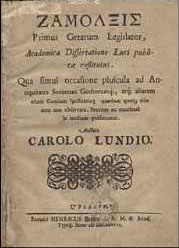
UPSALA - 1687
CAROLUS LUNDIUS
ZAMOLXIS – FIRST LEGISLATOR OF
THE GETAE
translation from Latin
and a few notes by MARIA CRISAN
translation to English
by Honorius Crisan
2001 - 2002
U pon a long dissertation within the Academy of Sciences, it is resolved to be made public this historical truth by Carolus Lundius, the author. On the same occasion, further data regarding the antiquities of the Sveons, the Goths/Getae, as well as other nations, such things never having been tackled before by others, is now brought to light, briefly, by the same author.
TO HIS SERENE HIGHNESS, MOST
POWERFUL PRINCE AND
MASTER CAROLUS XI,
KING OF THE SVEONS, GOTHS AND VANDALS,
GREAT PRINCE OF FINLAND, DUKE OF SCANDINAVIA, ESTONIA, LIVONIA, KARELIA, Bremen, Verden, Stetin, Pomerania, Cassubia and Vandalia, Prince of Rugia, Ingria, ruler of Vismaria and of the County of Rhenania Palatinate as well, Duke of the Bavarian Mountains, Jullich and Clivie, August The Most Faithful And Happy, my Most Best King and Master.
Most enlightened and all-powerful KING, most gentle MASTER!
May dear this humble, little book - and yet deserving the attention of an elevated spirit - be submitted to the bright eye of Your Royal Majesty; well, yes, since through it anyone would be able to recall things the little book speaks of and which Your Royal Majesty has, heart and soul, devoted to, as early as the years of Your youth - everything plentifully bears witness of it: I mean the German JUSTICE and EQUITY; to those two noble missions and attributes a rare finesse KINDNESS adds, which is cautiously handled by Your Royal Majesty, so the human wisdom perfection reflects in IT, so that, should such features be performed on a theatre stage, it would resound to such an extent with the shouts and applause of the mob, that it would spread all over and as far as the end of the world. And it is quite at all a miracle, as wherever such a show would be performed, wiping the tears and misery of that poor aggrieved people, and those wrongfully ill-fated/ wrongfully sentenced to jail terms /, would find their freedom and take shelter, in a complete absence of their concerns in the bosom of Your Royal Majesty; and why not other citizens, too, from other social layers, would find their rescue by having recourse to that Holy Anchor; by slowly steering their ship they shall eventually discover the very coveted port and the most peaceful place to drop anchor. So, that way the human condition and whatever other things recover, providing for everything that is linked together, keeping with much care both the general and particular things, even the state budget He fortunately constantly keeping, it is very usual He being saluted, acclaimed with one voice, fully deserving, that You - ah, You August, are KING and FATHER OF OUR HOMELAND (Pater Patrie). Whereas this Giant Man, no doubt by right, is surrounded in praises, everywhere and in the battlefield too He is loaded with praises both by the defeated and the winners, be they old or in their primes, so the praises I am bringing Him are at all insignificant over the highest esteem I should show Him. Then, why shouldn’t we say it openly: Your Majesty is nearby the Divinity, no doubt by right, since, as we can see, even on this small occasion - this book printing - He has involved. You really are the embodiment of the Great God who is believed cannot be deviated by any imperfections of the common people, or maybe insignificantly at all, since He gets by Himself higher and higher by any means possible. Look, Your Royal Highness, Your forehead clear at this all-modest homage, the books, not at all bulky, they lay down before You, with many bows, at the shrine of Your Majesty. For this little book I am grateful first of all to Your Royal Majesty and then to those devoted to me, who have supported its publishing, headed by Your Highness: may You in the future too be equally inclined to the requests, hopes and trust of those resorting to the generosity of Your Highness like to an all-mighty God of our dear Homeland, and of the whole Globe and may we have You well and happy as long as possible from now on, to the comfort of those needing Your Majesty! Most festive be that day and hold on with our descendants too, a day in which the heavens sent us that most brilliant star, a star most blessed, bringing with it on earth the goodness of a happy destiny - from skies they should send it again to deliver us from all evils. Why not, I would like the Muses would command my lips break silence and make a poem accompanied on the lyre, through the voice of which, in immaculate wishes, it would meet with the approval of others and at the same time I would be rewarded with applause and raised higher.
CAROLUS, You, King of the North, glory of the Earth, adornment of the world, most great conqueror,
Whom arts are singing, the virtues raising Him to the stars:
Justice, isn’t it the first praise? Isn’t the knotty staff
Hercules’ works, which all nations honour, with one voice:
Among the first nations, that of the Svions was by You, with armed hand, defeated
And how ever other peoples clambered on the walls.
And that way this Kingdom has been in no time turned into ruin.
For that was not our job?
To violently slam its body and joints.
Tell me you Muses, who did enlarge his country, its boundaries, through laws,
Tell me, who was the first to choke the terrible fires of the cruel Mars?
He was who choked them; He alone rebuilt it all in a moment.
This way glorious CAROLUS has raised above all, as He gave many people back their eternal life.
Through His grand Soul, This way also His CONCORD reign, imposing was,
The PIETY blossoms, the JUSTICE - mother of equality;
And may the old CURIA plentifully shine in
Senate’s garment. The citizens assembly to honour King Carolus in all respects,
He, who, having struck out the old criminal laws, new penalties set up, more just than others;
He, thinking by right that laws cannot remain the same for ever,
More fair laws He laid. According to Him, CAROLUS, the LAW is the holiest thing in the world.
HE, CAROLUS, all righteous and glorious, outstrips Apollo.
Long live Augustus, through Him alone all that’s good in our country is saved and prospers; may its powers soar, may it be safe from evil, as only this way it could aspire to summits;
His Queen - mother, who’s she - indeed Hedwig, born from noble blood, in a northern family.
Illustrious in the world, apart at all. Long live!
She, who embodies the GREAT LOVE for the people!
May she have only joys now and for ever!
Long live and blossom UDALRICA, the Queen-wife
And the greatest mistress in the world,
Virtue and honour model of heaven’s spirits!
May also the royal offspring blossom, worthiest of the Kingdom!
CAROLUS, first of all, whose sceptre so peaceful will stay
After He great wars carried, and shields in heavens would be left.
Remaining on the family destined, descendants; among them His grandsons count,
With similar destinies, of the same magnificence.
May He always enjoy only GOOD things,
May it be flinched by neither the things’ limits nor the centuries!
These all, my gracious Muse they wish you,
Singing your virtues on notes popped from their hearts.
Do accept, kind KING, accept, You, GLORY OF THE KINGS,
Accept these words born in my burning soul;
And, wherever I am, my words are singing You
On notes arranged with care, You raising, singing You, as better as can do,
Crawling on earth like a thin thread
And falling down to Your feet, the feet of YOUR SACRED MAJESTY
With a highly devoted faith
And too obedient as long as I’ll be living
MY WELCOME TO THE READER
T wenty-two years elapsed since, by a public vote, I was admitted the first in the Academy, to study the law sciences. As for my very spirit, my endeavour and thinking placed at the service of those sciences, I leave them to the judgement of those then admitting me among the students, and giving me thereafter frequent opportunities to hear their lectures.
During all this time I have committed to the paper, with great care, - not somehow neglectful, like others do - not corrupt, like others use to-, a great deal of those I’ve noted with my own hand during the University lectures. The only impediment encountered, should I confess and state it sincerely, it was that of making a selection of the many elements heard at the lectures; it was difficult for me to make a decision, the more that, during all that time, the number of manuscripts in question has grown, and in some cases, due to some ignorant transcribers, certain facts have been wrongly changed, not rarely unjustified omissions and additions being operated. Finally, our task was to carefully plan how should we move among that many winding paths, recognise our errors and, in consequence thereof, eliminate them. This is why I do not shrink from saying it, during those study years as a young magistrate, all that memorable dates have been well forged, more faithfully. Yet I do not doubt, there are certain people to consider what I have done less than correct, due to the fact that speaking about the beginning of laws with the Getae, I am referring in the first place to SAMOLSE (as this being the proper spelling of his name); they strongly believing that our erudite people would have inspired from the Greek letters, but the Getic letters, already invented and used then, the Greeks did not take from us, according to our ancient history and our wise men skilled in old writers’ literature, by such kind of persons, they wouldn’t be deemed as such; we would not give a dime for such persons, and the judgement of the posterity would condemn them - and they deserve to be condemned unanimously; this, because about SAMOLSE’s style (thus, the Getic writing pre-existed the Greek one) we have in evidence the authority of certain ancient historians writing down everything in every clearness. On that very occasion I would dare to prove that putting side by side the ancient laws of the fatherland and the Attic ones, we may find out a clear superiority over those of Athens, since at the beginning of the law, the lawgiver’s finger had to be put on with great care, and did so before those gathered for such purpose (so, it was some kind of a parliament - T.’s N.) So it was clear for everybody that any legalisations of deeds could not take place unless both parties were attending. Besides, we have in evidence a number of literary monuments having a completely overwhelming convincing force, attesting the Greek having taken from the Goth (Geta), in every particular, the essential element of the Athenian legislation, since words and fact as well are presented to and laid before us everywhere in detail, yet also on the whole and, if I keep silence, everything else speaks. But I have already passed beyond the stage of those small songs I have encircled myself in times of leisure, of a minimum importance; besides, save for the things that formerly, being actuated by the importance of the moment, it appeared to have investigated long time a separate volume. Besides, Great Grotius asserts, quite justified, the Persian language itself having its origins in the Getic vocabula; of such I did not doubt at all in asserting it otherwise than something very important, adding at the same time Arabic and Turkish, which however in our days, as I can see, use Latin letters, as determined in the printing shop, with the letters I have prescribed. May Heaven let come a time when all those and other like them will be published more accurately, even with same letters and fonts, in which they have been expressed in ancient times. Until then, affable reader, accept open minded those, as they are; should I obtain your acceptance, it would be for me an occasion for joy and satisfaction. As for the wrong ones, that would be for them a thesaurus, in order for the sad ones to always have occasion to amuse themselves, and those unworthy would hardly deserve a thing. To the latter I only have to say: the cedar and marble manners of Vossius (Gerhardus Josephus, German scientist, 1577-1640), (p. 112), have guided me, through the following most respectable words: “… therefore, in order for the prophecies (divine predictions) to be transmitted with the sense they have been received before, should comply with certain requirements. As for the other data in Latin, I deem it has been sufficiently discussed, as all words to be found in the quoted passage read. What could really be wished inside that treatise would be the reasons about which, for the sake of the Posterity I have avoided to speak of.
CHAPTER I
Summary
§1. ZamolxiV, SAMOLSES in our scrolls. To him are related the beginnings of the paternal laws and the defence of that truth. Who is he and where comes from? He belongs to the Getae, who are the same with Goths and Scythians. §2. The ones being called Getae are also called SVEONES. §3. Some deny they are called Svions from Svidur: their argument can easily be overthrown. §4. Before ODIN, there is no reference of that word in the writings of the old ones. §5. Sueons’ power extended once all over. §6. Whether the country is called Svia from Svidia, a region apart from Goths’ land. Why Svidia? §7. Why the inhabitants are not called rather Gautae than Svions from Odin: SVIFDAGR was born to Odin The Svif. §8 It is quite ridiculous believing that the name of SUEONIA could be related to the place and forest (VEDEN?), idem from ZWEI REICHE (two empires / a double empire). §9. SVIPIOD has a different meaning, while the name of Svions, who are also called Ingueones or Ingevones (in both cases they are spelt correctly); it is the same name with Ingi, Ingve and Ingemundr. §10. Those who have been called Scythians, thereafter called Sueons (Sueones). Where does the name of Scythians come from? For they come from the Elysium Fields, hence their name. §11. Who are the Hyperboreans? So do the foreign writers call them. Where comes the name of Wgugih (Oghiughie). The earliest authors mean by t hat word the trajectory of terrestrial days.§12. Once in our homeland, heredity was considered by the number of bows and arrows. What is the meaning of ARS and ARSDOBOLKAR in the earliest legislation rules. §13. The number twelve, of arrows, was deemed by the ancient peoples to be ordained by the gods; the number of nine days also had the same interpretation. §14. The Gothic SKUTA matches the Latin verb sagittare (“to take very well aim with an arrow”).
§1. The waxed tablets together with the other manuscripts, where
they talk about the origin of paternal (national) laws, they are referring to
SAMOLSE. It is not known quite exactly about him whether he was a
real man and when he was born. However, most authors assert, with
greatest levity, that he was born somewhere in the Thracian Land. About
that time, the Getae were living there, “Qreikwn andreiotatoi kai
dikaiotatoi ” (Hdt., IV, XCIII, to the end), that is “the most brave and
pious of the Thracians”, in Herodotus’ words. Among the praiseworthy
virtues, no doubt by right, that of undefeated is added, with which
Procopius (IV, Hist. Goth., 419) has adorned the Goths.
The ones who in Thrace were called Getae, later in Procopius’ (a Greek historian that died in 562 AD) time were called Goths and in older times they were called Scythians. Such authors we owe a due trust, since they are among the best ones; beside them, through his ancient dignity and authority, brilliant Messenius imposed, too (Foreword to a versified edition of the laws, signed Ragvaldus) who, in a few words, has shown with so much clarity and perspicacity that the first laws of the Svions and Goths (Getae) have been made up by Samolse. In order for such conclusion to necessarily be most correct, he clothed it with the word infallible. Subsidiary, if needed anymore, opinions have thereafter recorded, of certain brilliant scholars like BOXHORNIUS (Hist., VII, in the year 101), LOCCENIUS (Antiquit. Sveog., lib. I, chap.1), SCHERINGHAM (De orig. Angl., chap.IX, X. XI), HACHENBERGIUS (De orig. Sved., §XII, ff.), IACOB GISLON (in foreword and Chron. p.m.5 to the end) and in however other passages where the same opinion on the Getae, Goths and Scythians based on different proofs also in the mind of doctrine disciplines writers, such writers being among the most enlightened: that truth is perfectly confirmed by uncounted evidence. It is worthy retaining that unique truth, namely the Getae and the Goths were one and the same people and they were also called with the name of Scythians (Joh. Magn. Hist., S. 4, lib. I, chap.IV, f.f. Schol. Antiq. In Adam N. LXXXVII and authors next chapter)
§2. Therefore, they are called GETAE, GOTHONES, GOTHINI, GETAR, GETTAR, JETTAR, JOTTAR, GAUTAR2, GOTAR3, like with the natives, attrâ from GA, GE, which is the same thing with GAU, GO, JO, GIO, GOJA, i.e. TERRA from the verb GIETA, meaning to give birth, develop, spread open-handed (others have a quite different opinion, namely their names would come from GAUT or ATTYS, the son, loved by Cybele, of the Sangarius river). SVIONES, SVEVI, SVIDAND, SVAND, SVEAR, SVIANAR would come from Attys, more recently; who is also called ODIN, SVIDUR, SVIUR, SVIFR, FTOLSVIDUR, SVIDUDUR, SVIDRIR, SVIDI, from SVIDIA, meaning to devastate through fires. The following add, too: SIGFADUR, SIGTHYR, SIGMUNDUR, SIGTHER, SIGTHROOR, SIGI; and also GAUT, GAUTE, GAUTUR and WALGAUTUR, an assembly of administrative (business) names, which were en vogue at that time, designating both courage and wiseness and a charming finesse in every victorious people; a destruction of enemies’ fields, fires, sieges, has been also called havoc, ruin. Why not also Thràsàr (meaning more vulnerable to cruelty of cutting and burning, not rarely attacked to be publicly exposed). That is yet also name and cult object of the ancestor Attys through most useless games (caprices) and witchcraft; after that superstitions have invaded him, as we learn from the Eddic monuments (it is about two collections of mythological and legendary poems of ancient Scandinavian peoples, T.’s N.) at the location and with the inhabitants SVITHI-OD, SVI-THOD, it is transmitted to us that a new and perpetual name has been given from itself, that just mentioned.
§3. They are not even experts in old literary works that would deny such designation of ODIN. At first, for grammar reasons, his name should have been spelt that way, as coming from SVIDRIR, SVIDRISTHIOD and not SVITHIOD; those are some kind of sophisms, like some enigma that nobody can clear up. Yet the mass of scholars is too big for their boots, looking for vain glory, like our own ignoramuses, out of vanity, consider them admirable. Since not so much SVIDRIS, but at the same time under other flexional titles of names, Odin can be recognised, as already set forth above. In the case of such words in disorder it is always more clear if not expressed but in the case of a multitude of expressions relating to such word. Thus it is reasonable from GAUT or GAUTUR - GAUTLAND, from SIGI or SIGTYR - SIGTUNA, from SEMMINGUR - SEMMIING - HUNDRA, from RAUMUR, RAUMELF, RAUMARIKE, from INGI - INGLINGAR, from SKIOLDUR - SKIOLDUNGAR, and so we may find, of that type, with the thousands, where the second case, not clearly, but precisely, towards they incline, is to be preferred. See also moreover other historical documents - Thorstiens viikings soanr saugu (chap.I), where just the following words can be read: pad eru Kallader Alfheimar, er Alfur Konungar ried fyri. Afheimo from the king name of Alfo. What does it mean? That the assailant, in his opinion, would need rather to prove an alibi; for a similar reason, the word SVITHIOD popularly reads SVEON and moreover, and the whole matter, in itself, in such a manner it is said, that it can be carried through with a sword only.
§4. Then, that ODIN word seems to be much older than his coming into the world. Here it is, on what rely those claiming such a thing: sure thing is that that name has never been mentioned before Odin would appear, neither by foreign writers, nor by the native ones. They endeavour to impose the contrary with ability and through trifles, as resulting from the Eddic writings. that such is the state of things, As so it is in the foreword of the Eddic writings, where, in both books written with great care, they call DROTZET of the High Praetorian Tribunal, the heroine of the all-heavenly and companion, master, GREAT GABRIEL of Gardie, whom the Academy in Uppsala has since long: “… thadan for Othin i Svithiod, thar var sa Kongur er Gylsi het: oc er han fretti til Asia manna er Aesir voru Kalladir, for han i moti theim, oc baud seim i fit riki en fatimi fylgdi ferd theirra. Hwar sem their dvol thust i londum, ja thar par ar oc trutho men artheir voru theßradandr thui ar rikis menn sa tha olika flestum mannum othrum at segurd oc vitj. Thar thotti Othin sagrit vellir, oc Landzkostir godur, oc Kaus fier thar Vorgarstadt sem nu heitir Sigtun.” Odin left there for Sveonia, the king of which was Gylso. At him arrived the fame of the Asians’ names, which one called AESIR who, upon his throne mounting, invited them all: they complied with the invitation without delay. Wherever your eyes may have looked, you only could see but thriving crops, as everywhere peace was flourishing, among the local people of good faith, there were accepted with them those things that were well thought-out, while for others, the science and the excellence of the form were more alluring. Odin, where he saw the crop thriving and the soil being fertile, chose a location for the stronghold, which the local people call now Sigtuna, thadan, says the author, for Othin et Svithiod. From there, Odin came to Sueonia, as it is called today. With such name does it show off, but, except that, it was called before Svithiod as it is confirmed by the Eddic writings, as printed by the most deliberated Ressenius, in question being an edition resulted from a collating of a few more copies: Efftr thad for han nordut that sein nu heiter. Words that are completely the same, the Danish interpret assures us; it also tallies with the Latin version of the Icelander Olaus Magnus of 1629. Therefore, it is in question the same place that is called now Svithiod, that is Svecia. Of the same opinion also is Stephanus The Icelander Olaus when in 1646, he proves, the adorned interpretation of Haunia. However, about that and many other words, I deem as useless appealing to more precepts than it has been done before - it’s simple enough.
§5. Stress is being laid on the same issue: it is, undoubtedly, astonishing why resorting to other regions, the names of which did not come from the same name, on the contrary, their names read with those names with which they have remained since long. As it is quite easy for such an objection to be rejected. If in that passage of the Eddic writings so it was understood to be reproduced, where, in clear words, it is proved as more suitable that the reign of Sueonia should begin with Odin and where, after so many errors a reliable place can be finally set and, to the fęted person’s fame, it can still be invested with monumental names, which can be legally transmitted to the descendants. To conclude, by the name of Svithiod it was meant all that was in sight in the north; the other reigns were called at other times tractus (“vast country”), it meaning a reunion of lands of a very vast empire - at the level of the universe. In fact, it was replaced by the old ones with Manheim, Gudheim, Alsheim, Jotnaheim or Risaland / Vanheim, oc oll thau titi thar til halda (every reign that had to be haunted by the majesty of Sueonic Empire, as clearly asserted by Snorrus, accord. to Snorrus, in the version of Johannes Martinus, Slangerup p.1). The book, published in 1594, gives us the following information: “Norden for palude Maeoti ot swarte hass/ kalde de paa gammel Norske Svithiode. Det nafn haswe de paa alle diße kalde land som ligge mod norden/ oc erre somme af diße land öde fot fraast oc snee” (as author mistranslated the Gothic text in Latin, I dare to translate it, conveying in fact the essence: “Svithiod land being located north of Azov Sea, just in its most northern point, it has a very severe climate, the region being exhausted by frosty weather and snow”, T.’s N.) Let’s add to that source also Iordanes, the chapters (De Getarum sive Gothorum origin et rebus gestis, IV and V) in which we can find very clearly and well substantiated, from where and how arrived there for the first time the Goths (the Getae), that they have settled in Scythia, next to Black Sea and he describes already a number of settlements of theirs; from the notes of other writers, cited by Nicolaus Ragvaldus, in his speech (Herod., lib. IV), never praised enough. And it is in question not only the native writers, but to such also add some of other nations, in the words of whose we should trust with the power of truth comprised in them, having the strictness of purely scientific works: these are Herodotus (chap.IV), Xenophon (chap.11, Memoriale), Plato (Timaeus and Kritias) and many others nearer, among which one rises above all. This is Cl. Olaus Rudbeck (Atlant., chap.VII, §VIII).
Let’s go back however to Lucan, chap.II of De bello civili, from which we learn that our ancestors have roamed Europe, Egypt and Etruria and “have reached with their boats also Scythia Minor, at Lacus Maeotis, a black swamp full of all kinds of peoples.”
§6. So, in vain some endeavour to convince us that Svialand, the Sveonia region apart from Gothia, derives from Svidia, which means “to ravage”, “to burn.” Also, to destroy through iron and fire villages and forests, as in spite of the fact that the field, attacked inside, was, according to the custom, seeded and harrowed, everything was turned into graves, nothing having been sifted from the crop. The first to come to these lands called Sviar, which cannot yet be proved by any written document, worthy of being noticed.
§7. Although the name came into common use, yet the people wander why not GAUTA would rather be called the inhabitants, instead of SVIONES from Odin, as many centuries before the emergence of Odin, such name was given to those populations, like I set forth above and this historical truth can be easily proved through different peoples’ and nations’ history. Why then tarrying about this one? If however would anyone doubt the legend of the nomenclature, then one argument would suffice: why did not that ethnic group usurp that name before Odin. Lang fedgatal yet does not doubt that ethnic group having borrowed its name from Odin’ son, called Svifdage.
§8. From all these considerations is clearly resulting that somebody is nevertheless asserting that Sueonia can be inferred from Veden’ lake and forest (“se lacu et veden sylva”) – words mentioned above – an opinion which one could rather wonder about than reject. No less valid an opinion would be, that it would come from zwei Reiche (two reigns/empires), ideas about which Messenius claimed (Spe. Suec. et Goth, chap.VIII) they “render callous their errors by right and in fact.”
§9. From all stated above, it clearly results how much the concept of svithiod, I mean Sueons’ power or empire had to “suffer.” To thwart such a saying‚ a man (now passed away to join the happy ones) not a profane in homeland and ancient history, comes with an argument supporting the Sueons, Goths (Getae) and Odin; upon returning to the concept of Scandia everything getting mixed: undoubtedly Svealand is something different from Svearik or Sviavelldi, as moreover, other literary monuments of our ancestors, there are also homeland laws, under which it is asserted, in clear words, the following development: “Swerikis Rzjke a aff Hedhna Warld samankomit/af Swealand oc Götha”, chap.1 main Konungz Valter, e.e. (“The Kingdom of Sveonia, according to the last memory of the profane religion, has coagulated from the Sveonic and Gothic regions”). Same are the things in the case of the proper name of Svithiod instead of Svealand that clearly differs from GOTHALAND. accord. to the 1egend of Vilkina (p. d. 76): “Vilkini kunungr eignadist med rikinu, oc hernadi thad land er kallad var Vilkinaland en thad heitir nu Svithiod oc Gautland, oc alt Sviavelldi, Skaney, Sialand, Jutland, Vinland, oc oll thau riki er par til halda.” (“King Vilkinus, by the force of weapons, appropriated the Kingdom of Vilkinaland, which is today made out of Sveonia, Gothia, Scania, Selandia, Jutia, Vinlandia (Vandalsa) and all regions bounding that empire”). Thus, to spade a pikestaff, Svithiod differs from Gautland and Sviavelldi. And let’s us rely on the same history: af heiti ens, fyrsta haufdingia tekr hans riki‚ nafn, oc su thiod er han stiornar (from the name of its first prince the kingdom took its name, and not from the people the prince reigned over. It is entirely worthy being trusted, according to what is said above. So, from Ingve, or Inge comes the word Sueones and Ingveones. Ingveones, according to Plinius (lib. IV, C. XIII), and even Tacitus (De mor. Germ., chap.12); yet they do not call by something obscure or hidden, but even by something more open and clear, I mean they are those citizens who have been under the domination and authority of the Ingons. Ingi or Ingve, Inge or Ingemunder designate one and the same thing, as we can read in most documents dedicated to such name.
§10. But they also called Scythians, which thereafter called Sueoni, accord. to an old manuscript titled Chronicon. As Iaphet dre komne Skyter oc Geter, som langt epter Kalladis Gother / oc nu Swenske. (“Scythians and Getae were born to Iaphet who later, after the Goths, called also Sveons.”) But in no hand written laws collection that order is wrongly written. Even Isidorus (the beginning of that Chronicle and the next chapter) begins his chronicle as follows: the reign of the Goths (undoubtedly it reads Getae’s - T.’s N.) is the oldest, as it was born from the reign of the Scythians. Scythians truly are brilliant archers, they raising a lot above other nations, as that kind of weapons was specifically proper to them - just for that reason Herodotus (IV, 27) called them ARIMASPOI, “the ones who pointed at very well with the arrow” (although the legend says the Arimasps had one eye only, T.’s N.); they were mounted archers (ippotoxotai, Thuc. 11, 139); Laurentius Valla gave the same interpretation that later was also recognised by Henricus Stephanus. Moreover, Herodotus (I, 73) called that skill of wielding the bow and arrows tenhn twn toxwn, i.e. “the art of pointing at with arrows”, and Xenophon (On Socrates' acts and words, I, III, the Latin translator being Cardinal Nicenus), where it is said that, unlikely other nations, the Scythians and Thracians are naturally gifted with that net superiority in wielding a bow and arrows. Yet, unlikely the Spartans, who wield a sword and shield, the Scythians and Thracians do not dare to also conversely handle them, Spartans refuse to fight the first using their weapons - bow and arrows.
Lucan (Lib. III) also calls the Gelons sagittiferi volucres, i.e. “from the hands of which the arrows fly like birds”, and the Gelons are a Scythian nation. As Lucan (chap.II) claims, the Masagets are Scythian too, like the Gelons occurring about the Maeotis Lake, i.e. the Azov Sea, driving Scythian wagons or riding horses that flew like birds, like arrows. Through the art of wielding the bow and arrows our ancestors have stood out from other peoples, as our national history confirms it to us. Since they knew how to send an arrow with a perfect precision, they went to war or fights, their bodies bare, to show the enemy how expert are they in pointing at by piercing with their arrows exactly the targeted point. For their skill in wielding the bow and arrows e.g. Magn. Sigurdar. Sigurdar., Magnusa Barfots and the legend of Olof Trygfars (Flot. Lb., III, chap.8) and many other passages. So, the Scythians were among the first of our ancestors. The handling of the bow and arrows with the Scythians was learned since the early childhood; Florus (Lib. III, chap.VIII) recounts that a child would refuse the food given by his mother until she did not show him, through her self example, how is she hit by arrows. All their hopes were those arrows, as Tacitus (De mor. Germ., to the end) recounts. They roamed with their herds, herds of horses, goats and sheep through forests and untilted deserts, hence they were called Nomads, Shepherds, by Homer, Strabo and, among others, also by Silius (I, III).
They did not have any houses, living in wagons, roaming over the plains, and wandering as they did, they always had around the penates. Strabo locates them to the north, where the north wind blows, and Diodorus Siculus (Bibl. Hist., chap. p.m. 209) recounts that they were living on an island called Basilea out of which, in bad weather, came out a kind of very bright amber, which could not be found in any other part of the world: this was also called electrum. Urania, daughter of the skies, upon her father’s death, accepted to reign over Basilea and afterwards gave birth to dia docouV thV basileiaV, the devisees of the reign, Hyperions (Diod. Sic., Bibl. Hist., chap.III, chap.7, 9, 10, 13 and 14). Solinus adds that from the islands inhabited by the Germans, Scandinavia is the biggest and nothing in that island is more valuable than the glassware that offers both the crystal, yet also the amber, which the Germans call with a native word GLAESUM (STICLA). Plinius calls it glassware (XXVII, 1, 2). And just in our Sveonia, in the region of Helsingia, there was such a valley called ELYSIA [(the valley of glass = Glysisdal, Elysisdal, LIUSDAL), according to Ovid, Champs-Elysees according to Virgil, Glysis hed, Elysis hed, i.e. LIUSHED] (See also Tacitus, De mor. Germ., XLV; Tibull., I, 3, In Messal.) According to illustrious D. Gustavus Rosenhanus, who in 1658 chaired that province, he talked me about the places where the merchandise was exported from, like coming from the Elyzeens and Naharvals,who formerly would have inhabited those lands; Tacitus (De mor. Germ., XLIII) recounts about the Manimos [Manheimos] Elyzieni and Naharvali. Quoting Plutarch who, in his turn quotes Homer, asserts that in the Champs-Elysees is the end of the Earth, since there the shadow becomes visible putting an end to the Globe; there, where the light is prevented, and the descending sun just doubles the growing shadows, Radamantes’ kingdom, i.e. the Inferno begins.
Why from the Gothic lysa, and this, in its turn, from lius, liusis or lysis? Its origin is unclear, since in the summer those fields, as their name tells, are always seen to be bright; hence poets invented the wording “at the happy places of the righteous people”, “in the happy islands”, “where neither the winds blow nor the clouds drop their rain” and “the sky is always clear and laughs with a generously spread light” (Lucret., De rerum natura, chap.III, about the beginning) or in Horatius, Epoda XVI:
“The Planetary Ocean leaves us, we are surrounded by fields
we arrive at the happiest fields, at rich islands:
look, the field unploughed for so many years is being given back to us –
Ceres gives it us now flourishing and loaded with grape clusters.
the olive trees pull out their buds and every tree is adorned with buds;
the resin springs out of the high mountain oaks
and trickles through the bark down to earth.
There come from itself directly in the chapel’s censer …”
(See also the comments of Acronius Porphyrionus of Rotterdam, as well as of the others concerning the ode in question). Other versions concerning the origin of that region’s name may also be heard; among them, the Plato’s (Gorgias, p.m. 370 ff.) Virgil, for instance, sets against Champs-Elysees, Lacus Stygias (where Plouton, the “god” of the Inferno rules, T.’s N.), nigra Tartara, a place reserved after death those wrongdoers, unfaithful, where people shiver with cold (See also Hesiod, Theogonia, see 682, 721, 736 and Plato, Phaedron, p. 517 ff.) Both Stygii lacus, and Seneca’s Stygiae shadow, come from the Gothic STYG. The verb is styggias formidare (“to be afraid of the styg”); many other words have hence formed in our language. In Greek there is the verb sugew, having the same meaning, although yet the interpreters doubt its Greek origin (I deem it would rather refer to certain old Romanian words: 1. Strigă = “grey coloured owl with orange eyes, also meaning lady vampire, witch”, as well as 2. Strigoi, T.’s N.) (see also Virgil, Aeneis, p. 237 and 251). For good reason even the question is put, just where it has been called by the ancient people GLESARIA after: no doubt it comes from the verb GLA, meaning “to shine”, “to glow”, and hence GLEA, GLIA, GLOA, GLIOSA and LYSA = “to lighten” (It is not excluded it might be linked to the old Romanian GLIE, “ploughed land” and GAIA / GEIA / GE, “mother land” and of course the Greek must have taken it from us and not conversely, as it is too the case of wallach - from German, meaning “castrated horse”, as it is the case too of the West Falls (Westfalen) and the East (Ostfalen) and the Egyptian and Indian fellah, all those nations whose names are related to the land cultivation, agriculture, having their origin in the traditional word Valach, the oldest the Romanian ethnic group attested until now, accord. to Homer, Iliad, II, 739, T.’s N.) Since it is not like the case of the Latin Aquilo,-onis (“north wind”), Boreas in Greek, which asserts Aulus Gellius with serenity (II, 22) must have been formed from boatus, meaning “bellow” (’apo thV bohV), while some erudite men, who devoted themselves long ago to the letters and antiques, cannot approve of such an etymological explanation, believable among babies only.
§11. That is too the case of the toponym BASILIA mentioned by
Pytheas of Marseille (a famous navigator and geographer of the 4th
century BC, T.’s N.) as the seat of the royal Scythians: basileio V
meaning quite “kingly”, “royal” (Plin. XXXVII, II). I call as a witness
just Herodotus (IV, 56) in a passage where Gerrhos clearly recounts on
the county of nomad Scythians and that of royal Scythians
(“tón te tvn Nomadwn cwrion kai ton tvn basilhiwn Skuqewn”). Lacus
Maeotis (Azov Sea, T.’s N.) too is inhabited by the Royal Scythians and
the Sauromatians (“Maihtin, SkuqaV te touV
basilhiouV kai SauromataV”). This is how far the Sveons’ Empire
stretched once, as I already said here above (that is also perfectly valid for
the Geto-Dacians, who have lived for centuries, if not even millenniums,
mixed with Germanic peoples, both in the Scandinavian Peninsula, and in
the southern Russia, T.’s N.) Those Scythians who lived in Asia, it is due
to call them Nomads (SkuqaV touV NomadaV, Hdt. I, 73). On the same
island – BASILIA – the old ones called it BALTHIA from BALDUR or
Apollo or from the bows and belts (baltheis) which the Scythians used, a
respect in which it is worth mentioning Herodotus (IV, 11, 19 and 50, VI.
74), where he some times speaks about the bow, and other times about
Hercules The Baltic (centurion) and not only about Scytha as Hercules’
son, after whom the Kings Scythian have been called (Plin., 1.chap., Hdt.,
IV, 8, IX, 10). Apollo himself is called by Virgil The Bow Carrier (Verg.,
Aen. III). And in the 5th book of the same Aeneid says it explicitly: "Be
it now allowed us to explain how it came from the belt to the word Baltic
(belte) Sea, as it appears in ancient words. The Scythians called Royal,
were also called Hyperborean4, and their seat was in the Hyperborean
island, Yswer Norden, in Greek ‘uper, poetic super in Latin, Yser with
the Goths and Sveons, letters p and s are used alternately, either instead of
the other. „Same way could also be explained SCAN, nowadays SKAN /
SKANE, Scania being called in ancient times Scandia. As Scandia,
Scanau, Scanorum sive Scandorum island (Scans’ or Scanzs’ Islans), a
name under which we have yet another region located beyond the other
regions, getting in touch with the Aquilone (the north wind). That is why
Lucan mentions them as dwelling in a region located under the Polar
Circle or Hyperborean Ursa (De bell. Civil., V, p. m. 121), and Cicero,
quoting from Aratus’ poetry, he says: “consequently come the Northern”
(De nat. deorum, II, p.m. 47); Seneca calls the North Pole, by the
synechdoche Ursas: the icy wagon of the Hyperborean Ursa (Med. Act.,
II, cor. V, see 315).
In ancient times, our ancestors called it Scandia, it being confirmed, among other writings, by the chronicles inclusively. So, in laws fragments, among the oldest are also those prescribed the Sveons and the Goths in 1375, where Sveonia is called YSWERSTOG/OSTWANSTOG and NORDANSTOGH (Diod. Sic., Bibl. Hist., p.m. 91 ...) From the tradition of the old ones, as Diodorus shows it, so it has been found to be graphically represented. The inhabitants of that island have been called by the ancient peoples Hyperboreans; all the more it is trustworthy, as such judgement is placed in the beginning of the book. The Hyperboreans have been called after the adverb ‘uper, “over”, “beyond” and BoreaV , “North wind”, therefore the ones who live beyond the whipping north wind (Plin., VI. 1 3), and in his scholar, Adamus (p.m. 149, 111, 83): “the Danes, the Sveons and the Normans, as well as the other Scythian peoples have been called by the Romans, Hyperboreans; those Marcian loaded with praises of all kinds.” The Greek writers (among which Diodorus Siculus, Lib. III, p.m. 132) and Plutarch, De facie in orbe Lunae, p. m. 941), called them western, Atlantic, and Hyperborean populations; Tacitus (De Mor. Germ., CXLV) recounts: “beyond the Svions there is but a tranquil sea, almost still, surrounding and enclosing the Globe.” Among all the other Scythians, the Hyperboreans were some very special people, as RUDBECKIUS emphasises it.
§12. In our laws, both older and more recent, there are not only the arrows mentioned, but also always the bow and the arrows are mentioned together. In inheritance matters, where a succession was to be decided, the one of the sons was deemed more fortunate and hence more powerful at wars, which inherits twelve bows: that one was to be called, in fact, a Scythian. And, as the codices prove, in accord with all the other regulations, he had the title of agent through heredity – ARFDABOLKER, ARF meaning both “arrow”, and “bow.” Since an estate was regarded depending on the number of bows and arrows, a custom transmitted also to our Getae ancestors descending from the Scythians, the true Scythians were only deemed to be those possessing three times twelve bows (“thre tölptir SKUTHA stràng ok bogha”), and by the word ARF it is meant both “arrow”, and “bow.” That way of judging was also reflected in the heredity title - the more the number of bows and arrows a son inherited, the more appreciated he was in the battlefield; here he is, instituted in the context of a hunting: “If someone, in his own forest, therefore, in his own hunting ground, upon having cornered a beast, feels exhausted and wants to have some rest, so discontinuing the hunting, sends on the beasts trail a bow or an arrow; and if that beast is subsequently killed by others, those due is the skin, and that who was the first to shoot an arrow is due the rest of the beast; and should a dispute arise, then they would resort to an arbitration by good faith men (I suspect it isn’t meant a proceedings in court, yet instead a hunters’ association assigned to settle such differences T.’s N.), thus everything is to be settled with an elegance that characterises us” (I wonder if that is neither the ontological-gnoseological root of an old Romanian say “To sell the skin of a bear in the woods”?, T.’s N.)
§13. I have said that, in our laws, by the word ARF it is meant not only an “arrow”, yet also a “bow”, which is called too ARMBORST. The wording ARMBORST ATARS BRESTER has the meaning “the arrow is shot with a bow.”
In our laws, both old and recent, it is only mentioned as weapons the bow and arrows, hence their name of Scythians. According to information supplied by Kongbr (chap.XXIX of Codex Magni Erici and c. XXIV of the general law (Civil Code) of King Christoph), the warriors wore twelve arrows each, to match the number of gods, accord. to Virg. (Georg., I, p. 41): “That is why over the endless earth reigns the sun gilded by those twelve stars of the world.”; in Homer (Iliad. I, p. 2, see 3) we find the digit 9 to be used: “for nine long days the arrows of Zeus flew in the army.”
§14. From the foregoing quoted passages, as well as from other sources, it could be seen that Skyta meant, in our laws, “to shoot by a bow and arrow”; it results more clear from VOSSIUS, SCIOPIUS, CELLARIUS and BORRICHIUS (De variis linguae Latinae aetatibus: Defensione Vossii adversus Sciopium).
CHAPTER II
Summary
§1. It can be precisely proved with nine solid arguments the terrible weapons of the Goths/ Getae would have wandered all over the earth, set out of Scandinavia. §2. About that truth none of the ancient writers ever doubt; that thesis is supported too by several colonies spread all over the world. §3. According to Jordanes’ confession, if it will be approved of by everyone, it would be an extra argumentation. §4. According to Procopius, it isn’t in question as much the Goths, as especially the Langobards and Vandals. §5. That fits, his name, very popular, being Langobard by origin, Paulus The Langobard Warnefridi. To that it is also to be added the authority of a DEXIPPUS, ABLAVIUS, EUNAPIUS, AMMIANUS, DIO, ZOSIMUS, ZONARA and of many others. §6. The old history of the Fatherland comes to an agreement with the ancient annals; it is just the same with the oldest Greek writers. §7. Those come to join the Spanish, too. §8 As for the Italics, a debate would prove useless. Why should it take place, so long as the Scythians are the founders of Italy, too? That truth is confirmed by a series of very old words, since countless of them are of Scyhtian origin, as we can tell it very well. §9 The Gauls or Francs themselves have come from our Scandia and why not the Trojans, too. What else it would be meant by TROY if not LAZIUS (Lazio, -orum, accord. to Plin.,VI.12, is a nation in Colchis; accord. to V. Pârvan, Getica, 281, 363, 777, as well as the opuscule Dacians in TROY; see also M. Crisan, Die Lage der antiken Städte Troja und Theben aus Böotien in der Bronzezeit, T.’s N.) §10. The land of Amazonia, KUENLAND in Scandinavia. In SMALANDIA’s VERENDIA even these days the honour remained as a permanence of ancient valour and body strength. §11. The Britons originate from the Saxons, Angles and Getae. §12 Yet either the Scots don’t know they are descending from the same stock. There arose firstly the nobility of the whole Europe from, a truth confirmed by Carolus Quintus. §13. Even the Germans were born in Scandinavia. §14. The Helvets likewise. §15. Not less the DANS and neighbouring peoples. §16. And what is believed about the Moscow inhabitants, who draw on the source of old Gothic language (read Getic, T.’s N.) §17. The Cyprian words tally perfectly with our ancient lexical rules. §18. At the time the first settlement of the Goths (read Getae, T.’s N.) was set up and where the place of those who have migrated is determined. How many likewise causes have generated migrations. The first expedition of the Gods, when did it come to live. §19. A majority of the writers agreed it was that of the Goths (read Getae, T.’s N.) and they set out of Scandia; there are too few those denying such opinion over those asserting it. Their reasoning spells as follows: From Kranzius to Valdenselsium is everyone that thinks accurately. §20. Yet America, as it is called today, our ancestors have given nothing at all? There are no opposite opinions, on part of anyone: therefore, more likely the answer is affirmative.
§1. I deem it was enough reasoned to say it clearly that the Goths and Getae are one and the same (that is the first author I came upon that made the points in that dilemma, which M. Eliade himself could not crack, T.’s N.), the most undefeated by their virtue and exploits and known under other names as well; both the titles and cities and peoples are common to them; they have subdued many other peoples by siege, bringing them under their ruling. Why? Like from the sown earth comes out the green grass, the knotty stem wheat rise lithe from the surface of the earth, its ears jutted out like from a womb, I wonder if not likewise have come out too of our Scandinavia, at different times of the history, a huge host of settlers, who have spread, from that womb, all over the world, as we may see? Such fact has been affirmed accordingly, long ago, by Jordanes, naming the same Scandinavia “a plant”, “a womb of the nations.” Those were indeed the Getae or Goths who often have roamed, both before and after Christ time, the world all over and conquered it; in support of the thesis that they have left Gothia come several proofs. And first of all, that historical truth is asserted by: I. The monuments of ancient poets, which ours call SCALLDI; their descriptions rely on such proofs, which, by their nature, are immutable. They are inferred just from the skies, the sun, the sea, lakes, springs, rivers, trees, mountains and others; hence the truth itself can be clearly discerned. II. A full consistency of the national history with that in the books and annals. Like Olaus Petri (the author of a Chronicon) overlooked to specify it, I myself don’t know which way they have been uprooted by others and taken by force to other places those Goths. Given the circumstances, of a very high uncertainty, in fact for unknowing the truth, they have been included in the preamble of the Chronicle in a ridiculous and stupid background. III. The general consensus of foreign writers, which we hardly can make out. Why? For almost no place does exist, neither so long nor hidden, which the Goths’ virtue terror had not filled, at that times. IV. The laws of the Ostrogoths in Italy, the laws of the Visigoths in Spain; beside others, even many of the Langobards, Burgunds, Francs, Alemans and other nations , (V.Aug. Buchn. Saxon. Soll., p.m.43 the ancient laws of different peoples and stocks), of certain and obvious origin, as their name show, perceived as such with the eyes and mind. It adds here also a confirmation by King Carolus IX regarding R. Christophorus’ Common Law; and not only the Stiernhielmus’ foreword to the West-Gothic laws, which, had not been so edited at the beginning, but in an intrinsic bundle of ancient laws by Lindenbrogius. And it must not be overlooked what, in his speech, that Ill. The Scythian Johannes, dealing eruditely with just those Gothic laws, asserted with elegance the oldness and military virtue of the Sueons and the Goths. And what a unparalleled talent to write by hand that most beautiful opuscule, this is why in very few copies and by so few it can be ever used: just for that reason I never doubted a moment it has been transcribed with greatest care. Which, in a seamless succession of words, shall read: What more do you expect? Olaus Magnus recounts he would see with his eyes in Italy, in Peruse (a city in Etruria, located between the lake Trasimene and the river Tibru - T.’s N.) a book of Gothic/Getic laws, written in Gothic characters and, despite the oldness of that literary, legal monument, as of course many years elapsed from the time when the Goths lived in Italy, was carefully preserved and kept by the Perusians. That book is a volume containing the laws of the Goths, gathering an assembly of laws, which the Suets and the Goths make use of these days, too, so the same laws have been discovered, which are effective now, too. Such a consistency of the contents of the laws led us towards a very certain argument, namely the Goths, when leaving for Italy, took with them the law codices, too. The more ample authority of that Olaus has been outlined by the illustrious man Joannes Metellus Sequanus, the most brilliant historian of the Roman Emperor, Rudolf II, who both me, and the most noble man Johannes Rosenhan of the Torp settlement, made public in the dwelling of the Ruler of Neuland, Carolus Uthenhov, and always asserted to have browsed through that book, even before the 50s, together with brothers Joannes and Olaus Magnus. Why? For that most brilliant Prince, Master Fridericus, Duke of Braunschweig and Luneburg, has shown that most brilliant and powerful Prince, Master Carolus and designated as a King of Sweden and my most merciful Master, with a noble attendance of the most noble people, not how he has shown before, but the same book, with who he had been in Rome in Peruse and who he has seen with a special admiration. As far there was III. Scythian. But several monuments have been seen – signs of an ancient virtue of our ancestors, the Goths, over Italy and many other kingdoms on the occasion of their wanderings, with great significance and in good order drawn up in their travel diaries, as it is the case too of that brought to light by chance, by the noble young man Johannes Gabriel Sparvenfelt: it is happily and with cleverness annotated; thus, thanks to the destiny governing everything, they could finally be recovered. V. The ancient paternal Laws of all the Goths and, partially, regarding the West-Gothic expeditions, both that military, in Greece, and in other places, in a word, there are clearly mentioned the migration regions. VI. The customs, letters, language, sacred things and other concerning any relations with the exterior. All these have been clearly stated at their places. Sure thing, Grotius (Proleg. Hist. Goth. Melancht. in the Busbeq Chronicle. Ep. IV. Scal. lib. III) stresses the idea that by the Sea of Azov, even in our days, there are alive the customs, the language and names of the Goths (i.e. the Getae’s, T.’s N.) He adds several names in the Persian language five of Scythian places, places over which Persia had ruled for a long time (so, because they were inhabited/reigned by the Persians, they got Persian names, as the case with us with the translation into Slavonic of many toponyms purely Geto-Dacian, at the time of Slavic peoples invasions, leading to wrong solutions on part of those linguists not knowing the history of the country, or, pure and simple, even if they do know it, they mystify it, T.’s N.), only now, for the first time transmitted. Then, about the current use of some Gothic words in Chersonesus Taurica (our days Crimea) and in Tartaria Praecopensis, most illustrious men, like Melancht., Busbeq., Scal., Vulcan., Boxhorn., Rachel. Even our Verelius (Chron., p.m. 338, Vulcan in ad. dit. Not. in Jordanes, Boxhorn. Hist. Univ. ad. Rachel De jure Publ. Imp. Germ. CXIII), has shown on the text margin and in the notes to the additions operated by Vulcanius, that more than a few of those words are absolutely Getic. For the same reason, the other can also be referred to the same origin, seen on the same writings. Right this is a reason for being worried, as expressed in the recently appeared book by the illustrious man Wolff and already gone Verelius, which we leave to be brought to a good end. VII. The natural migration of the peoples towards south are the words belonging to Cromerus (I, I, CXV, by R. Pollon). “It is much more common”, he says, “that the north peoples would migrate towards south. It is the case of the Cimbres, Goths, Vandals and Langobards.” As I said above, what did separated the Goths from the other peoples, it was the health and body robustness; the respectable writers assert the same thing: since they have white skin, fair locks of hair and are one head taller than others. By such qualities blonde Ceres would give birth to a grand offspring, like Lucan sang (Lib. IV, De bello Civili, p. 104); beside others, that one was Procopius (Lib. I, Hist. Vandal.), who added: “The Gothic nations have been manifolds once, but also today. The noblest of all are the Goths/Getae, Vandals, Visigoths and Gepidae who have also been called ancient Sauromatians and Melanchleens. There are some who called those ones Getae.” (It is very clear that, right as everywhere in his book, as he did in fact stated it, the Goths is the same as the Getae, T.’s N.) But those, i.e. the Getae, do not differ at all from the Goths, but by their names (see also Maria Crisan, Ubicuitatea Geto-Dacilor – annexed to Arta poetică la G. Coşbuc and Limba strămoşilor noştri şi primul poet Romano-geto-dac, Publius Ovid Naso in which the author speaks about the vowel alternation e/o; so the Goths are nothing else than tribes of warlike Getae, as they were inclusively at the mouth of the river Dnieper–Borysthene, as Dion Chrysostom attests it in Getica, Getae not yet settled, T.’s N.): all having white skin, reddish fair locks of hair, very tall and with handsome faces. They have common laws and neither the cult of gods tells them apart. This is what Coelius says through the mouth of Horace (chap.II, chap.XXI, in Horat. Epod. XVI): “And neither the savage Germans could be tamed by the invasion of the blue-eyed Teutons and Cimmerians (it deals with the invasion of the Teutons and Cimmerians held by Marius in 102 and 101 BC at Aix and Verceil, T.’s N.) They are leading their life beneath the North Pole, as Vitruvius (a Roman architect of the 1st century BC, author of a valuable architecture treatise, T.’s N.) leaves it to us‚ they are very burly, have a white skin, straight and reddish hair, blue sky coloured eyes and have much blood; as a result of a humoural abundance, they are very frost resistant. While the people living in southern regions are much shorter, dark-haired, curly-haired, dark-eyed, sick-footed and feeble-blooded.” Bonfin. (l.c.): “I don’t know what a special and proper thing would affect to such a degree the human being in relation to the place of birth - that only by the exterior appearance, by the body constitution, one can forthwith tell apart a German from a Gaul, a Gaul from a Hispano and, to be more specific, an Insubre (The Insubres were a people of Cisalpine Gaul that lived in the present Milanese region having its capital at Milan, T.’s N.) from a Ligurian, a Ligurian from an Etruscan, a Roman from a Venetian, a Venetian from a Florentine.” The same way as Procopius speaks about the Goths, also Alphonsus Carthagian and the Emperor Constantine The Porphirogenet recount (Anat. Reg. Hisp., chap.IX, Const. Porph. ref. Hachenb. Orig. Germ. n. XVIII to the end), and the same does Lucan (De bello civ., lib. 11).
“The Scythian Masaget does not halt at the Hister, he roves through towards the far north, to the fair-haired and white-bodied Suevs6.”
Mutually agreed with them, Lucretius expresses himself, too (De R. Nat., lib. VI):
“What a distinction, frankly speaking, between the skies of Britain itself
and that of Egypt, where the blue vault bows,
Or between the sky of Pont and that of the city of Gades,
and that of the country where live the bronzed-faced Negros.
So, there are four all-distinct realms,
Since each of them has its wind and share of the skies.”
(Titus Lucretius Carus, Poem of Nature, translation, foreword and notes by D. Murăraşu, Bucharest, Minerva Publishing House, 1981)
See also in Tacitus’ (De vita Julii Agricolae, chap.XI) the passage where he recounts about the sky position that had given the human bodies a certain habitus; and in Diodorus Siculus’ (Bibl. Hist., chap.8, p.m. 212) who mentions the Gaulateils’ hairs growing in accordance with the nature (ek fusewV). See also in Cicero’s (De Divin., lib. 11, p.m. 1 23), who in his turn comes to, by very clear words, confirm quite the same thing. “Why? He says: a distinction between places, isn’t it ever naturally to entail also distinct offspring in people? Those we can easily review: why are there so great differences between Ethiopians and Syrians as regards their bodies and souls, as different as their homelands are: wherefrom it could be understood that at birth it matters more the position of the land (homelands) than the trajectory of the Moon.” VIII. At the Attendant on the Holies in almost the entire Christian Universe, at the Royal Council that thing has been told by the energetical Nico1aus Ragvaldus (the then representative of Wexionensus, sent to the said council, thereafter even High Pontiff of Uppsala (see C. Stephanus) which everyone subscribed to, a thing included in the Documents executed at that Council and even in the history. Such thing also occurs in the speech held there and together with the annex of a solemn contestation, published both in Latin, and in the mother's tongue. IX. It is disputed the authenticity (aύtentikvV) of the confirmation given the laws of CHRISTOPHORUS‚ King of Sueonia, Dania and Norway, which are preserved to our days in the Archives of the Kingdom (the Ancient History by Ablavius, conveyed in manuscript confirms the laws of the Kingdom of Sueonia having been common with those of the Danes, since they are undersigned by the Kings of both kingdoms. And such arguments are important, since by us, the lawyers, it is understood an eviction (evincentia) and which just “on such an occasion, almost only at a sign (by the thumb, I guess, T.’s N.) it could suffice to obtain it (I think it deals with a recognition/confirmation of the authenticity of the laws in question, T.’s N.)
§2. I already said in the preceding paragraph this being the common opinion of the writers: that is the power of the truth entailing a unanimous consent. And among the historians who did really doubt it? If, for too much concern about novelty, you deny such a thing, then you would need to deny everything: if you say it is a lie coming from the old ones, then you have to say that everything is a lie. So, what a force more powerful than the history’s, which you should give credit, than the old mandates conveyed to us through the monuments. And why just them, in point now, the Goths, the Langobards and others; there it is confessed they have left for many corners of the world: in what directions and how; by the own confession of everyone, as living beings, gifted with sight, prudence, of those whose memory did not yet get to sleep, I note it is my duty to completely reveal the truth and dissolve the misunderstandings.
§3. So, let’s start with Jordanes, himself a Goth (i.e. Geta, T.’s N.) who extracted his work from the ancients’ writings; he recounts the Goths having come from SCANZIA (Scandinavia of our days) just like a bee swarm (De Getarum sive Gothorum origine et rebus gestis, C. I, II, III, IV, V). He then shows us what means that SCANZIA and the nations living there; thus, making use of a reach vocabulary, he reveals the way the Goths left their dwellings. So, he calls our Scandia a plant of peoples, a womb of nations. Further on he shows us the extent of the eastern and western Goths have spread, although Getae by the voice inflection (thus, singing, because they did sing their laws too like psalms, proving that their language was harmonious and melodious, a feature proved also by the fact that Ovid could adapt the Latin prosody to the Getic language, see the poem Laudes de Caesare, T.’s N.) called those peoples Ostrogoths and Visigoths. So, we should understand: with another troop of Goths they left Scanzia (under the ruling of King Berich (read Herich), Jordanes mentions; things about he spoke above, he now repeats them on short.
§4. Procopius (Hist. Goth., IV, fragment, p.m. 241 and 248) takes
out the Ostrogoths and Visigoths from the same Scanzia, as well as the
Langobards (so, he added that to the same history fragment, relating to
the countries inhabited by the Goths). Same way does Procopius7, adding
to them other uncounted Vandals (in Tacitus’, De Mor. Germ., chap.II,
we find under the name of VANDALS, in Procopius’ and Zosimus
bandiloi, and in Eutropius ouandaloi, with the versions Vandeli, Vindili,
Vinili, Vinuli, Winili, Winuli), with the Goths affirming their common
origin: Goqoi te eisi kai Bandiloi kai Ouisigoqoi kai
Gepaideς (“Goths are also the Vandals and the Visigoths and the
Gepidae”, Hachenberg, Orig. Germ., XIII); that the Vandals have
adjoined to the other Goths, it confirms us an issue of great confidence
(Procop., Vandal., lib. I, lib.IV, chap.39) - under King Gilimer, who
enjoyed a great sympathy; he had under his leadership the every and the
most noble offspring of the nation; among the writers enjoying the
greatest confidence is Grotius (Proleg. Hist. Goth.)
§5. Alike Paulus too, in The Langobard Warnefridi (De Gestis Langobardorum, lib. I, chap.II), as himself confesses, mentioning his nation, it proved that its inhabitants (the Langobards) together with the Goths, leaving our Scandinavia, approached Scandinau. Johannes Boëmus (De Mor., leg. et ritibus omnium gentium, lib. III, chap.8) calls it with the same name, yet also with many others; then also in Ptolemy’s we find mentioned Goths living by the Vistula. Naturally Mela too (lib. III, chap.6) calls them identically, with the same word. The same way does Plinius (IV, 1 2), as well as Solinus (III, 19 şi 20). Right here, in Scandia (just how Plinius said) Isidorus asserts (Init. Chron. Gothorum) there was the oldest kingdom of the Goths (= Getae, T.’s N.) And as he very accurate mentions, it came out from the Kingdom of the Scythians. For that reason Dexippus (lib. II) entitled his books dedicated to the matters of the Goths, Ta Skuqika (“The Exploits of the Scythians) to make clear every good faith writer that historical truth (namely, the Getae descend from the Scythians, T.’s N.) And Eunapius mentions the Scythians in a blurred language, idem Ammianus; and Ablavius Gothus, in a choice language, speaks most accurately of all (Nicol. Ragv. Orat., p.m. 165 ex Ablav.) But Dion Chrysostom, in his book about the wars of the Goths, calls them Getikon, “Getic”8 (here Carolus Lundius makes a serious error, for it is common knowledge that Dion lived in the 1st century AD and wrote a treatise titled Getika (Getic Matters) from which JORDANES/JORNANDES inspired himself, as Lundius calls him again and again, while the Goths (even if the same thing with the Getae) appeared in the history, certainly detached from the Getae, only in the 4th or 5th century AD, T.’s N.) Let’s add here Zosimus and Zonaras too, in many passages of their works; beside them, Plinius himself counts the Getae among the Scythian peoples (IV, 12); the same with Trebellius Pollio (Vita Galieni et Claudii), where the Austro Goths are included in the set of the same nations. Anastas comes to adjoin here, too. (Hist. Chronol.) Skuqai oi legomenoi Gotqoi (“the Scythians that are called Goths”). Rosendius (Antiquit. Lusit.): “Many peoples”, he says, “draw their Gothic names from Scania, a thing overlooked by the old writers and confusedly presented under the title of Getica.” Jacobus Bergomensis (Suplem. Chron.): “Peoples that have been called by the Greek and from which Scythia and Gothia drew their names.” Schedel/Senensis: “the Scythians from which Svecia and Gothia draw their names.” Heinsius, in Paneg. Gust. Magni asserts: “The more recent geographers unwittingly made a distinction between the ancient Getae and the Goths. They didn’t realise that the Getae and the Goths are pretty alike and in several books by the old ones, the authors rely on both the testimonies of the Romans, and those of the Greeks, since they share both a common name and origin.” From here Ferrarius recounts, relating to that historical truth, recollecting the most serious writers whose authority compels like a marble stone (Paneg. R. Christ. laud. dic.)
§6. But all these assertions do not coincide in every respect with our histories and the ancient Annals of Sveonia? Of course they do! Af Japhet are komne Scyther och Geter, som longt epter Kalladis Gother / och nu Schwenske (“the Scythians and the Getae draw from Japhet, and later on, after the Goths, they were called Sueones” (accord. to Chron. and Hist. Pat.) I now pass by the Scythian Empire stretching over the whole Globe and about which fully recount Herodotus, Xenophon, Strabo, Diodorus Siculus and how many ever others and in how many ever passages and whose assertions fully agree with every major history and national annals.
§7. About the Hispani Alphonsus de Villa Diego The Hispano too heard (Chron. Goth. Regni p.m. II): “Gothia is in Scandia, he says, the natural fatherland of our Gothic people, where themselves set out, and where they still have their Royal and State residence.” To such assertion consent Roderic and Tolet, too. (Rerum in Hispania gest., lib. II, chap.4); Joh. Lup. (De J. et J. Regni Navari, VI. 4): Alphons. Carthag. (Anac. Regum Hisp., chap.IX) and others.
§8. As for the set-out of the Goths from there to Italy, Italians themselves witness it with one voice, which by all means served as an argument in the History drawn up, partly printed, partly hand written, kept in the Library of the Vatican in Rome, not both in Latin, as rather in Italic dialect (isn’t it by chance just the old Romanian language, I mean Geto-Dacian? T.’s N.), in it being included the Exploits of the Goths, as conveyed to the Posterity. It didn’t propose itself so much to bring great praises the Goths with elegance and firmness, as it tells us illustrious Octavius Ferrarius (Pan. Chr. Reg., p. 7, 8, and 19). Connected therewith also Sigonius (De regno Ital., lib., I, p.m. 11) proves that the Goths themselves would not have given birth the eternal empire of the Romans in Italy, quite conversely, since, as I was saying, the Scythians were the creators of Italy. Among other writers concerned with the origins of the Goths/Getae, also counted Cato, from whom there have preserved fragments that survive in our days, too (so, less than four centuries ago, Cato Maior’s book, The Originis of Rome, in which he also recounts about ancientness of the Getic writings, still existed or at least fragments of it, T.’s N.) So it wasn’t surprising when Plautus called Italy barbarian (Poen III) II, 21). The Italic priest of Hercules he called Poticium The Barbarian(Poticium = Pinars, -orum, an old family in Latium dedicated to Hercules, T.’s N.), and the Italian ritual, barbarian. The Italian cities have got the epithet of barbarian , too. The Italian or Roman laws have also been labelled as barbarian (Bacchid., I, 11, 15; Casin., II, VI. 19; Chap., IV, II, 104 and III, 1, 32) and translated into Latin in a barbarian manner. And why not should I say the holidays, too, as well as others, have been deemed as barbarian, once such names were accepted with any peoples, except for the Greeks. Even the oldest words that were by origin Tuscan (from Tuscany in Etruria, i.e. Etruscan) and Scythian, are clearly convincingly Gothic (indeed Getic!, T.’s N.), accord. to Plautus., Asin., prol. II and Trin., prolog. XIX. The verb pultare (“to strike lightly”), which Plautus uses very often, comes from our pulta or bulta (Latin French Dictionary, the 5th edition, Hachette, 1923, provides us with the following explanation: pulto,-are is an archaism for pulso,-are, “to strike”, “to knock at the door”, it meaning in Plautus “to slightly knock at the gate/door” and, whereas the comic poet Titus Maccius Plautus, designated as an inimitable painter of bad popular habits, lived between 250 and 184 BC, it is quite obvious that all the barbarian words present in his comedies come from the Geto-Dacian language and not from the Gothic itself, Gothic being in its turn an adorned Getic, as old sources reveal it, more so that the Goths (in my opinion, quite at all far from Lundius’ opinion, T.’s N.) they appeared on the stage of the history (the East Goths and the West Goths - Ostrogoths and Visigoths) in the middle of the 4th century (350-375), with Amaler and Hermanrich, respectively (350-375), an empire, destroyed by the Huns; W-G under Alarich (395-410) invaded Italy (in 410 they took over Rome); Rekkared (586-601) > Catholicism; their last King was Roderich (710-711). W-Goths their last king, King Teja, falls at Vezuv in 552; they disappeared in 601 AD, so their ruling extended over a period of two and a half centuries. Thus, with not even a trace of doubt, every barbarian word used by the talented Latin comediographer Plautus are created from the Getic language, since the Getae and the Dacians had arrived on the Italic soil long before Rome has been founded and remained at home as such, to which have adjoined the prisoners of war - some of them reduced to slavery - therefore the characters - slaves of the comedies, both Greek and Latin are called simply Davos or Davus, Getes or Geta (yet there was a Roman Emperor, Antoninus Geta, among those seven Antonins Emperors (Nerva, Trajan, Hadrian, Antoninus, Marcus Aurelius, Verus and Commodus). Antoninus Geta (born in Milan in 189) was Caracalla’s brother, with whom he shared the reign and who killed him in 212 AD, thus at the age of 23. Caracalla ordered to be executed over 20,000 people; he was also the murderer of the jurist Papinian, because he refused to make the apology of Geta's having been murdered (so those state rulers killing also their next relatives descend from that hateful Roman emperor, T.’s N.) The verb mulcare (“to milk”) is not a Latin word, VARRO (116-27 BC, a poet and one of the most renowned scholars of his time, from who also a treatise on the agriculture, De re rustica, has preserved; so the author relies on very reliable sources, authors that lived centuries BC, reinforcing the idea of having to deal with a pure Getic vocabulary, T.’s N.), yet Gellius too admits it openly (Noct. Attic., lib. XI) chap.1). As neither the verb mulctare is Latin. Since, in fact, in the same way, by milking, the milk is drawn from the teats (udder), which by a sermone vernaculo, i.e. a popular word (in Varro, however, by the words vernacula vocabula it is meant “Latin words”), we say mulka, molka (Thys. and Gronovius in Plautus, Stich., III, 1, 19; Fragm. Legum Sueon. et Goth., chap.XVI). There are some asserting that mulgeo and mulceo (“I milk”), herein and mulcto or mulco (“I punish”) would come from the Greek amelgw (“I milk”), while in fact it is suitable to look for a common source, first of all, in Scythian. Halophantam, a word we know it occurs in Plautus (Curcul., IV, I, 2), as well as in Salmasius and Scaliger, as the commentators of the same passage, (but that word can perfectly be derived from hal and fante and we deem it being wrongly connected to the Greek olofanthV (a word that appears neither in Bailly, Old Greek Dictionary, Paris, 1929 nor in E. Legrand, ample modern Greek dictionary, Paris, printed about in the same time period; I suspect it being a pure legal term, used in the Middle Ages, which could be found in a specialty dictionary), meaning “the requirement to appear before a court of law", “to pay a bail for someone”, “vessel”, an expression originating in Sueonia and that can be connected to a similar wording, occurring again in Martial in his 9th book, T.’s N.); same are things with the word bustirapus (at origin meaning “thief/graves desecrater”), Bust-ei-rapr, which in the old Gothic language/i.e. Getic means “man”, is used by Plautus with the same meaning, of “bald man”, having no hair on the head to be entitled to be called a full man (vir bonus); in Plautus (Merc., V, 2, 85, and Rud., II, II, 9) the word MACHAERIA is used with the meaning of “small swords”, it being the old Gothic word MAEKER, from where also the Greek macaira (“meat chopper”) took it; de socco, socca (from the word soccus, a special low boot put on by the comedy actors), used by Plautus in his Boastful Soldier, last act (comp. with Mercat., V, II, 85; Rud., II, II, 9 and Edd. Havamal., LXXI) is Scyhtian by origin, and the Gothic SOLA (see Bacchid. II, III, 98) answers perfectly that word (we should not forget that always in question is a Geta or a Geta too, when he says Goth, T.’s N.); SCURRA (“buffoon”, “sycophant”, “trickster”) which with the ancients meant “to utter idle talk/sarcasms to trigger the laugh of others”, takes us to the meaning of SKURA of our national language, meaning “prattler”, “babbler.” Yet what status have other pure Scythian (i.e. Getic words, T.’s N.) which occur frequently in ENNIUS, PLAUTUS, CATO, VARRO and many other authors, from whom we quote a part: vinnula, cista, cistula. cistellula, herus, herilis, heres, heredium, herediolum, caput, arca, arcula, cippula, nasus, denasare, casteria, claro, clarifico, claritas, claror, claritudo, clarigatio, mundus, mundare, vocare, advocare, fallere, velare, stygius, carcer, carcerare, gelu, cura, curare, stare, urbare, turbare, nomen, nominare, meminisse, taberna, tabernarius, catus, catč, nicere, nere, nictare, sputare, insputare, caupo, stega, puteus, potus, putus, putillus, baltheus, pipare, pipire, boreas, rica, ricula, ricinium, acheruns, boia, rosca, pellis, palla, pallium, pallula, palliolum, palliolatus, paludamentum, paludatus, palatum, palatium, specio, cum compositis, specto, speculor, spiculum, speculator, speculum, specus, spelunca, species (a majority of those words also occur in present German language - fein, kiste, Kapitel, klar, Palast, Niere - not only in Romanian, proving once more that our ancestors shared a common history with Germanic peoples, we lived in the same regions, the Vlacho-Geto-Dacians and Carpian peoples spoke the same or almost the same language as the Cimmerians, the Celts and the Teutons, the Getic laying in fact at the bedrock of all, in its bosom being he writing, too - T.’s N.) Reverting to the ancient word PAN, analysed here above, we found it is at the same time, Greek, Italic, and Germanic, since originally it is a Scythian/Getic word. i.e. Getic. To the Latin legere (“to read”) it corresponds the Greek legein legein, and lesa/läsa in our language, and in Wulfila legunt (“they read”) (Math., VI. 26) occurs lisan. Zythus, and in Diodorus Siculus’ ZuqoV is neither an Egyptean nor a Greek word, from zew zew meaning “to boil”, yet pure Gothic (i.e. also Getic, T.’s N.), since the Greek ZuqoV reads with us seth sodh, where th is expressed by th or dh (Arngrim confirms it, lib. I, chap.III) and from him, also Verelius (Runog. Scand., chap.VII, chap.III); hence has formed the verb sieda, siuda, in German sieden, meaning “to boil”, “to thaw.” We say, for instance, a drink of boiled barley; the Greek teirw, in Latin tero (“I crush, crumble, grind”) comes from our verb teira/tera, wherefrom handtera (“to grind/crush by hand”; qin or qiV qinoV (“pile”, “accumulation”) is said to come from qew, meaning “plenty”; for such a derivation I won’t give a dime, for it is clear to me that it comes from the Getic tina, since in Cicero (Orat. cont. Rull.) we have cogere (“to gather”) and coacervare (“to pile up”). Even the noun montes (“mountains”) is used as an equivalent to maximi (“the biggest”), acervi (“loads of cereals”) in Plautus (Pseud., I, II, 55). The Latin aevum (“duration”, “time”, “century”) comes from the Gothic/Getic äwe and is quite close to the Greek aiwn and the Arab avan (thus, there could be built whole sentences in ancient Getic language, based on those extremely valuable etymological formulas the current Romanian also keeps the ancient Getic word ev, T.’s N.) Compare to what Celsus says (Com. Eccl., p. I, chap.8 – dealing with a philosopher renowned for his attacks against the Christianity, who lived in Rome in the 2nd century AD, under the Antonins). I now refer to Plato (Crat., p.m. 319) where we would find several Greek words received from the barbarians; I also refer to Dionysus (lib. I, to the end) who clearly asserts Rome having at first made use of the Greek language, wherefrom many words penetrated thereafter into Latin, mixing up with Latin (so, the Latin language has took a lot from the old Getic both directly, through the Geto-Dacian population in Rome and indirectly, via the Greek language, T.’s N.) I also refer to Julius Caesar Scaliger (an Italian philologist and doctor, one of most scholars of Renaissance, 1484-1558), author of a brilliant treatise of poetry, T.’s N.) from whom we learn that old Latins took over uncounted words from Magna Grecia. I also refer to illustrious Morhosius (lib. De patav. Liv., chap.XI) who conveys to us the information that in Italy have existed more languages: those of the native slaves, but originated in other regions, as well as those of the house; each of them had its own language, an opinion which I fully agree to, yet wanting to underscore that many of the Latin words were of Scythian origin. Even the odd number comes yet not from the Greeks, but from the Scythians; erudite people have shown already that both the flexion of the verb, and that of the noun in Latin have a barbarian origin, for instance; karkar, karker, karkeris, karkeri = carcer, carceris, carceri, (“jail, of the jail, to the jail”). In karkarai, according to Wulfila (see also the Glossary of Wulfila The Goth, as well as the ancient laws Codices Pat.) ai reads as being an e, in carcere, as the sounds themselves au and ai read e: namen, namnis, namni = nomen, nominis, nomini (“names, of the name, to the name”); father, fathris, fathri = pater, patris, patri (“father, of the father, to the father”); mother, mothris, mothri = mater, matris, matri (“mother, of the mother, to the mother”). And in verbs: im, is, ist = sum, es, es, (“I am, you are, he/she/it is”); vidiau, videis, videithş = video, vides, videt (= I see, you see, he/she/it sees); vastiau, vastis, vastit /or vastijt vestio, vestis, vestit (“I put on, you put on, he/she/it put on”); au with the Goths reads like o or ó; haba, habas, habaith = habeo, habes, habet (“I have, you have, he has”). from the Gothic haba it came to the Latin habeo; therefore haba is habeo, habas - habes, habaith - habet, habam - habemus (“we have”), habaith - habetis (“you have”) and habant - habent (“they have”). Haba is today hawer. Pretty sure thing, habetus is instead of avitus (“had, held”, but also “stout” in Plautus) and habe instead of ave ("may you have"), according to Non. And Bongars. Ad Justin. (lib. I, chap.I‚ 4). So, it is easy to connect things together in such a way, as to conclude those words not only having pre-existed in Gothic (Getic), but also they having been adapted and translated in Latin rather at the mercy of anyone; even the acceptation of the verb is often construed in Plautus and Terentius a little too boldly, when they want to say that a woman has been had (haberi) it is added cum coit (“has been possessed/has united through a marriage”), which in our old laws would be expressed with some chastity and never would be elaborated in such a manner.
§9. It is now the Francs’ turn, about which many convincing authors
speak, among them Freculphus too (loc. cit.), who makes clear as follows
“they have arrived thereat from the island of Scanzia (= Scandinavia)
which is in the womb of the nations, that an exodus took place, by which
the Goths and the other Teutonic peoples have left, as proved by their
language and idioms.” The first to live in France were the Celts (such
thing happened in the 1st century BC, T.’s N.), through the yoke of
which the aboriginal populations, the Gauls, have been submitted and
eventually they adopted Franc names for themselves. Nothing more true
than this: that the Gauls of Gaul or Galgavia have been useful to the
Sueons. See Atlant. Cl. Rudebeckii (chap.XXXVII). It has been called
JOTNAHEIM or RISALAND, i.e. The Land of the Giants, as certain
fragments in ancient histories have sufficiently proved. They have been
called Resar and even Kallar or Gollar, and region itself Kailand and
Gaulland .It is clearly written in the Eddic documents; according to
others, they called Gallar and Geyter, or according to other assertions,
Geter, Gyller etc.; even by the name of Kimbrar, Kappar and Gallar.
Hence the name of Galatai, Gauls, Galatae, eumekeiV kai leukoi (“tall
and fair-haired”), asserts Diodorus (Bibl. (Hist. e. p.m. 212). As we shall
see, a same statute shall be granted the Trojans, like in the case of Gauls’
origin, who lived in the Celtic Gaul, an opinion unanimously accepted.
The Trojans are the same with the Sueons, and Troy is the capital of the
Nation, a monumental city of which preserved but ruins, once very
powerful, as a seat of the kings of Uppsala, wherefrom Uppsala kongr
(“King of Uppsala”), as being a Sueons’ king of the whole Globe: among
the ancient monuments wholly trustful, we quote the foreword to the
Eddic writings, having exactly the same significance with the assertions
by Diodorus Siculus (Bibl. (Hist., e. m.p.132) that the Trojans spread in
the fields have gathered at one place, eiV polewV peribolon or peribolhn.
Peribolh, since Troy was surrounded by walls; the verb periballw is
formed of peri, “around” and ballw, “to throw”, “to build”, since it
looked like a well built castle and principal place of defence of the
stronghold (polewV), so peribolon designates Troy9. I said Uppsala
kongr, where the noun Uppsala is a plural. This way were things always,
the singular never being met in ancient authors; therefore, it always
should be written UPSALIAE, in plural, and not UPSALIAS or
UPPSALA, in singular; the plural again is used in the case of other cities,
like ATHENAE, THEBAE, SYRACUSAE and other towns alike. That is
too the origin of Trojan colonies (R. Magnus Ericus’ Law Book, Eddic
Writings, legends 3 and 7). According to Monaster (Chron., p.m. 113),
Homer (Il., in different passages), they have been the Goths (read Geto-Dacians, T.’s N.) from the family of which came out the Trojans. Homer,
as an author of the epic on the Trojan War, made annotations not so much
about the Greek bodies as especially the Trojans’ ones, they being very
stout and handsome at that time, resembling the gods, qualities they may
have lost in time (note that Homer was born 169 years after the Trojan
War, we learn it from Herodotus, who dedicated him a little book, On
Homer’s Life and Works, T.’s N.) We often find in Iliad annotations
like oisi nun brotoi eisi, “those look now like common people, that is the
difference the centuries have marked” (See also Val. Paterc., lib. I,
chap.5). Sure thing they have been called Gaullar, Jottnar, GETTAR,
GETAR, from Ga, GIO, Jo etc. (so the same etymon as in the case of the
Getic word, T.’s N.), i.e. they have been called Earth, for that reason they
having been called by the ancients Giants, sons of Terra, GigaV (“giant”),
from ge (“earth”), which in the Doric dialect is ga, meaning the same
thing (see the Eddic texts, the legend V,18) and Diodorus, Bibl. (Hist.,
III, p.m. 142).
Here are some lines by Hesiod (Theog., V, 147 and 183):
“Ostai gar raqamiggeV apeotuqen aimatoestai,
PasaV dexato Gaia periplomenwn d’eniautvn,
Geinat', ErinnuV te krateraV megaloV te gigantaV.”
“All that heap of tears shed, mixed with blood
all the Earth sucked in, in order for them to, years thereafter,
return to him as sturdy Erinies and great giants.”
Orpheus himself masterfully sang the Giants fed by Terra also with the blood in the skies.
“Ouneka geV egenonto kai aimatoV ouranioio .”(Orph. I, 8, s.s.)
In the same way opines Tacitus too (De mor. Et pop. Germ., chap.II), like other writers too, when speaking about the origin and customs of the Germans: “They praise in old poems the God Tuiston, grown on Terra, and his son Mannus, as creators and founders of the nation’s origin” Tacitus., d.l., chap.IV, and lib. II, Annal., chap.XIV); they are very stout, underscores the Latin historian; “their look is savage” (Histor., lib. V, chap.18; chap.XI) Vit. Agric.) Let’s hear also what Saxo Grammaticus, the Danish saying (lib. 11, p.m. XXX): “Her are the cruel and fierce-eyed Goths, their look likewise, threatening with their aquiline helmets and noisy sticks.”
Claudianus (lib. II) adds about the Goths living in Phrygia, how together with the Ostrogoths and Guthini, they farm the Phrygian field…
Therefore it is fitting to give attention to the codex manuscript. In what particular way there can be distinguished the Giothars from the Guthars (see except the very old law fragments (Kunungsdr. Vpp., chap.XXIX, chap.1) and many other documents). Region Smaland (a country in south Sweden, located in the Götaland peninsula, T.’s N.) called Guta (as it called once by Ptolemy, we learn from the foreword at Joannes Magnus’ History, first book to the end). There it was the stronghold - capital of those Colerus (a commentator of Tacitus (De mor. Germ., chap.XLIII), comp. with Homer (Il., III, 96, f.f.) and Virgil, Aeneid, p.m. 1 52), called it Calmaria (CALMAR, a stronghold and port in south Sweden and capital of the province with the same name, T.’s N.) Right that is the brilliant Trojan stronghold, Troja, having strong walls. One of its gates is called Skaear (Scheana Gate), in Greek Skaiai, in Latin Scaeae, the vaults of which have been praised by Homer (Il., III, 96, 30 passim) and Virgil, (Aeneis, I, 2, p.m. 152).
“With barbarian gold and through spoliations the renowned gate has been built.” And yet, Virgil too (Aeneis, chap.III, see 1-3):
“After the gods deemed it right to ruin the power of Asia,
through no fault of it, they exterminating the Priam’s people,
Ilion when perished and TROY sunk in smoke…” (trans. after G. Coşbuc)
According to Hachenberg (Orig. German., I, 28; Laz., De Migr. Gent., lib. III), the Trojans or Phrygians, Cimbrians and Francs were originally one people; just for that reason it is dealt with the Phrygian Cimbrian language, i.e. the Teuton language firstly spoken at Troy.
We also learn from Virgil (d. I, III) that all the holy things, the Trojan deities are in fact those of ours:
“The son of Tros and interpreter for deities, you, the skilled in
Signs given by the laurel, the Phoeb and the holy tripod,
Given by the stars in the sky, the flight and song of birds.” (trans. after G. Coşbuc)
§10. Petrus Trecensius Gallus (Rud. N. praefat. ad lat. leg. Ragvaldus’ version), praised somewhere here above by Joannes Messenius, recounts more ample the Scandinavian Goths: “The ancient ones called those nations, the descendants of which have populated the most part of Europe and Asia, rather Getae than Goths.” A too scrupulous censor rejected such an opinion. It has been in turn defended by Cicero (Verr. Divin., p.m. 56, Sturm Publishing House) through the following words: “…although completely oppressed and ruined regions, yet populated.” Then, the same thing Gallus said: “There is up to our days a very large region, having at north Norway and Dacia, and in the other parts being surrounded by the planetary ocean.” And yet, how it differs from Sveonia: “…that nation, he says, is very strong, since by its military power has subjugated most of Asia and Europe for long time, only being scared by the courage of Alexander the Great of the Greeks when he attacked them. Even Julius Caesar’s invincible power, who defeated the Gauls, was terrified by the German fighters united with the Danes, the Britons, the Norric Goths and northern peoples, as well as other peoples. Among them there were also the Amazons who marched in front of all, as recounts Orosius and Isidorus” (lib. XIV). Ferrarius, as above mentioned, abundantly confirms all these qualities of the Goths wandering around almost the whole globe. As for that women population, I told you more here above. Sure thing, the writers recall it unanimously, having only words of praise for them. They have come now in Smalandia’s Verendia (the Country of Amazons, according to our ancient writers, is Kuenland and Konogard. See also Verel. Hervarar, the legend c. I, where our ancestors call it Conogardia), in very vast lands, enjoying the esteem for the ancient physical power. as for the silk military fascias, they call feitteckn; these women wear them at feasts too, as I’ve seen with my eyes, and as for the heredity concept, they are admitted, dealing on equal terms with men; as regards other things, they are worked out based on a common jurisdiction for women / confused = promiscuo jure / (I suspect some kind of an agreement between them, ad- hoc, at random, T.’s N.), accord. to Joh. Magn (D. praefat. C. III to the end; Adam Bremens, De situ Danorum et reliq. Septent. Reg., chap.LXXVIII and XC.)
§11. About the Cantabrigiensi Britons (Angles), Cl. Seringham (De orig. Anglorum c. VII) he says: “Those are the Getae which afterwards have been called Goths; setting out from Scanzian Peninsula, they were the first to occupy the neighbouring islands. From there they left for Chersonesus and the neighbouring regions, where our ancestors had left some time before; until they came there, those regions have never before been inhabited by other nations” (Id., chap.I and II, 5). The same thing he recounts about the Anglo-Britons who draw from the Angles (so the Dacians always will be the same with the Getae, and the Getae one thing with the Goths, T.’s N.), who at first were called by the old Britons to help, with whom they had to carry a terrible and long war and the same, through many battles, finally they have defeated them (for that reason, many authors praised them; among such also Arngrimus Jonas (Criin., lib. I, chap.III). “These letters (meaning the Gothic Runes) I do not relate to Norway or Iceland, but instead to the tongue that called Danica and which is still spoken in Dania (and also in Norrigia), now Norvagica, or even to that old Gothic”, which, which even in that time I think to have been spoken all over the Aretinian country (in ancient times Etruria, with its later developed cities: Tuscany, Arezzo ...‚ in any case, in the Antiquity it was inhabited by the Etruscans, T.’s N.) and extended to the neighbouring peoples; idem England, Scotland, Ireland. Since about Angles we got very clearly written, it dealing with that language of Norway also used in Wilhelm Nothus’ time: such things are asserted by Arngrimus (Cryin., lib. I, chap.3).
§12. “In no way we are dealing with a Scottish name fraud, if he admits himself as a descendent of the Goths / the Getae, while the most powerful kings of the Hispanics are glorified as ones to took away the coat of arms from here; even the most noble of the Italy draw their stock from the Goths (i.e. the Getae, T.’s N.) or deny their origin; and subsequently even the Emperor Carolus Quintus used to claim that in fact the nobility of the whole Europe set out indeed from Scandia and Gothia through filiations.” So spoke Camdenus (Britann. de Scotis, p.m. 40 and the following)). The Emperor Carolus Quintus, in his letters sent the King GUSTAV I of Sueonia, also containing some memories, confessed that both he and his kind draw from the Goths’ stock. Concerning such descent, some princes have been more ambitious, as Munsterus recounts (Cosmog., De Regnis Septent. lib IV c. XX): “… the Goths’ glory comes from Scandia”, and the Roman Empire is an absolute result of that Goths’ glory, which, upon penetrating by foot in Italy, they have laid vast Rome and maintained their reign many years over Italy; they occupied Gaul, established kingdoms in Spain and raised the most noble prince's houses (in fact, Spain has been invaded as early as 600 BC by the Celts - a German people group that upon mixing with the Iberians, gave birth to the Celto-Iberians; in 19 BC, the whole Spain has been occupied by the Romans. In 400 AD the Alans, the Suets and the Vandals overran - all of them being German ethnical groups that, in 415 yielded their place to the West Goths, which formed a kingdom destroyed in 711 by the Arabs, from their kingdom only lasting a strip in the north of Spain; thus, Spain owes a greater part of its culture the German peoples, i.e. including the Geto-Dacian, T.’s N.)
§13. About the Germans as a nation, there it is what Paulus Fagius, himself a German, asserts (Lib. De Meth. Hebr., p.m. 56),: “… the Gothic nations (peoples) everywhere they may have come in with their armies, have also brought their language, either fully, as it is spoken today in the German regions or corrupted, as it happened in Italy, Spain and Gaul.” It has been only recently proved (it is likely to be a work issued around the year 1687, when Lundius published his book, T.’s N.) that the Teutons have born from the Goths (meaning the Getae), see also Gulielm. Postel., De origin., Versteg. annotated by Cl. Shering. d.d.chap.VII); according to Versteganus, in Scanzia never got any peoples confederated, recounting the number of people of Germany being so great, that it would be necessary to establish colonies or, by the word of the author himself: “that they were constrained to seck habitations mor nor ther ly”, it meaning they have been compelled to leave their fatherland in the northern regions, for housing reasons: that was the state of affairs. The whole prosecution background concerning that item is disclosed in court by the above praised Cl. Seringham yet where, by his fellow countrymen’s testimonies, the charge has been rejected pretty convincing, and the rationale, if anymore, is vehemently denied, too.
§14. The same the Svizers (the Swiss), and the name itself reveals the origin of the people, since it is about Svevia that we deem by right and as a matter of fact, on juridical grounds, as being ours. Stumpfius himself, since long a renowned writer of the great and flintlike Swiss people, for that being praised even by Hachenbergius (Orig. Germ., q. XX), citing from the ancient author Gilgus Tschudus, plentifully confessed that the Suevs’ ruler, accompanied by a lot of people, descended from Scandia, gave his name, deeming it as holy, noble and everlasting, the places he crossed, as well as their inhabitants. And Julius Caesar Scaliger (1484-1558; not only this Scaliger, one of the most erudite Renaissance men, a renowned philologist and doctor, and also author of a dissertation on the art of poetry, called Julius Caesar, after the name of the famous Roman general, who was said to have descended from Venus and Anchises, but also Pope Julius II (1503-1513) and according to the works they have completed, it clearly shows that names to have been fated, T.’s N.), since in the funeral oration held in public in the memory of those Germans fallen in the battlefield near Vienna, we can read as follows: “Wherefrom do our days Swiss come in fact? If not somehow from the villages of those, yet also from the neighbouring strongholds, very powerful, in Svecia, which the citizens occupied, so that under the influence of the name and their fatherland name, they have been called Svizers.” No doubt the distinguished and loaded with praises scholar Hachenbergius, in his work, On the Origins of the Germans, by way of all kinds of reasoning, based on reason, no doubt by right, draws the following conclusions: “From these it clearly results it is difficult to deceive them, since the Germans ar a native, honest, enduring, and fair people, as it may be easily seen. Neither the Germans nor any of their peoples plunged into actions for sincerity glory’s sake. The more recent ones spent the century in wars, so that the Spaniards, Italians, Gauls, Svecians, Danes and Hungarians, having nested in Germany, coming also by the right of the marriage, have mixed their blood with that of the Germans. That way it might be explained why a great part of them, if you want to LOOK INTO THE PRIMARY ORIGIN, one almost cannot tell them apart from the Germans, because, in fact, they descend from the common mother of the European peoples, i.e. they came from Scandinavia; this is why that great Swedish King, GUSTAV ADOLF‚ in 1627 urged the German army to come back to the old regions, shared by the Swedish and Goths alike, under the jurisdiction in effect (utendi jure).” That fact is properly mentioned by Goldastus (lib. II, chap.V, De Boh. Regn.), when he wrote that the Germans have complied with an order by Gustav Adolf to come back to their native places. So, It is therefore with guts to give credit to such and other legends like that, childishly fabricated; identically, it is not advisable to deny them without a prior judgement. “Nor are happier those taking refuge in other places, be it that endless wilderness of Asia, to regain the unknown race of the origin of their people, to so avoid any wrong theory on the birth of the Goths and Huns; as they are known to everybody through a vivid proof too, of the Nordic peoples, the Goths draw from Svecia, being born in that kingdom, in which even today lasts the race of that people, preserving the same names.” These were the words of the wisest Werdenhagens (Rerump. Hanseat., p. III, chap.1). As regards the name of Semnonum, a name by which are designated a hundred of inhabited villages, as Tacitus wrote (Annal. and Lib. De mor. Germanorum), a region in the Kingdom of Sveonia, called Semminghundra, witnesses to our days for that old toponym. All the same are things with the other Svev peoples, which I’ve discussed herabove.
§15. Even the Dans neighbour with them; it proves both the people that remained there and the blood. Why should I recall the land of their ancestors, since themselves admit what is confirmed by the old chronicles of Sveonia, the lapse of time, the oral tradition, and the further course of affairs, and by literary monuments that truth has clarified beyond any doubts (V. Sambl. Swenst. Cron. in vita Herici I, at the beginning and Chron. Rhythmis comprehensum in ejusdem vita) I also have regard to a study recently published by me and annotated by Rachelius and Hachenbergius; in a book by the latter, (Orig. Dan. Et Germ., n. XII) the author says: “So, as well as we hear the Nordic writers asserting about the Dans and their deeds, we learn that the Goths or the Getae, leaving the Scanzia Peninsula, led by Erich, occupied firstly the neighbouring islands. It was then that the Danic (i.e. Danish) Nation has established and the whole region along the Baltic Sea was alike populated by the Danes (Danish).” In witness lay the writings of renowned historians, among which the Danish Saxo Grammaticus, too (History of Dania - Saxonis Grammatici sialandici viri eloquentissimi, in gesta Danorum, Francoforti, Apud Andream Wechelum, 1581, lib. II, p.m. 30 ff., but especially in Book I, T.’s N.), in which it is recounted us about the undefeated power of the Goths as a certainty.
§16. All the same could be also said about the Moscowers, since their language drew on the issue of our language; that truth of their History is confirmed by Sigismundus Baro Herberstenius (of Helmold. Snorr. Olaf. Tr. and Hervar Saug. Verel., in the notes of c. I, Herv. Sigism. Bar. Herberst., in Hist. Mosc. and Hachenb., (De orig. Sved., chap.XXIII, to the end). Hachenbergius recounts - a report received by the writers with a unanimous consensus - namely the Goths left our Sueonia taking with them over the whole Globe the fame and fear of their name and the fact of being surrounded in everybody’s admiration.
§17. “Nowhere in the world, on the whole Globe, we don’t know to have been ever mentioned the name of Gotlandia, with its regions and the name of the Ostrogoths’ land, West Gothia or Wisigothia, in a context different from that of the power of the boundless Kingdom of the Goths; and Jornandes, Ablavius, Dion, Procopius, Agathias and others who wrote about the Goths’ / the Getae’s History claim their abode to be in that northern part of the world, where the Goths (the Getae) have settled, for the first time, in ancient times.” Those were the words of Chytreus (Foreword to Herod. and Thucyd.’s Chron.) What would I look for more clear or trustworthy? What could be ever said more favourably about our laws or the local people? If I’m not wrong, all the same is the meaning of the words in the beginning of the first chapter cited from Konungs br. EE: “Konungsbr. Twenne aro Gothai Swerike / Ostgotha och Wästgotha: Ey finds Gotha Nampn i sterom Landô fast ständande uthan i Swearijke: Forthy at aff them uthspreddis Gótha Nampn in annor land / som Skrifften sagher.” (“The Goths, so they have been called until now, are denominated by those two nations in the Kingdom of Sveonia, the East Goths and the West Goths. And they don’t even define two different nations that would have remained as such to our days, but in Sveonia. So, from them the name of the Goths has spread and propagated into other regions, as historical documents do assert”). So they became extinct, since nowhere in our days is anymore used that obsolete name (of Ostrogoths and Wisigoths). But where it is need to make distinct the name of that people, it kept, since by arriving at regions very far from their origin fatherland, they took it with them to Dacia, Moesia, Italy, Spain and everywhere they settled it has preserved as such.
§18. About in the time of Sarug, the grand grandfather of Abraham, an exact number of years after the world having been created by God and / less ICCCC (1900), as recorded in the annals of the ancient fatherland: “Tha lifde Saruch goder madur / Abraham Patriarchas fadur fadur”: (The first of the Goths that broke apart were those leaving the port have arrived at the Baltic Sea shore Baltic Sea). In the following passage that reached us out of a series of ancient scrolls, we shall learn some words relating to the foregoing context:
“Aig war i watalum näkor til
er plugum mundi tha wända:
Góthana ginstan Heirikr mild
Tog utan Runung athsämdir.”
(These lines we find rendered in Latin in the History de omnibus Gothorum Sueonumque regibus by Joannes Magnus Gothus (chap.I, chap.8, in Vita Erici I):
“The Kingdom of Dania was arranged in colonies .-
as long as in the fields of that region
I ordered the Gothic/Getic peoples to live
Yet under no king.”
Comp. with Olahus Magnus, Historia Septentrionalibus regionibus ...‚ c. IV, chap.27, chap.V, chap.1 and Johann. Messen. Spec. Sueon., chap.III; Petr Upsal., Chron. Sueon., lib. I, chap.6 and Chron. Dan., Hauniae edit, Anno Christi I CCCCXCV (1495), in Vita Humeli).
(The most important thing to be noted in the Gothic - i.e. Getic - text seems to me to be the word plugum, which Joannes Magnus returned by the synecdoche agros = “fields”, in accusative, about which we know to be one of the oldest Geto-Dacian words, plug, which we may find again in present German in the form of Pflug; the best proof that things are this way, is that to our days that word presents identically with the ancient one; besides, that is the case of many other words and syntagma, among which also the demonstrative pronoun ista, occurring also in Cato and Plautus, preserved identically especially in the tongue spoken by the Moldavians and Bukovineans, T.’s N.)
The second abode of the Goths that left their native place was the Vistula River flowing into the sea nearby the Dantiscus Bay (it is indeed the port city of Dantzig, situated at the Baltic Sea bay with the same name, near the mouth of Vistula T.’s N.); the third place where the Goths settled was Transylvania and Dacia; the fourth in Thrace; the fifth in Pannonia and Moesia; the sixth in Illyria, finally, the seventh was in Italy, from which they moved to Gaul and Hispania and have occupied their regions (that configuration of the Goths’ scattering over the Globe matches exactly the regions occupied in old times by the Geto-Dacian-Carpians, Etruscans, Pelasgians and other peoples related to our ancestors - first of all German, accord. to every ancient source, starting with Homer and Herodotus; a repetition of ancient history in the Middle Ages, by the Goths (i.e. the Getae / also the Getae) is confirmed inclusively by our days English historians; among which André Maurois, too a name in the matter T.’s N.) See, except the old authors, already mentioned, and Chron. Vetustum Sveoniae (chap.II and III), Smabl. Minst.; Klint. Kron. In Vita Er. I, and the following two kings, where there are also enumerated the subdued kingdoms as far as Egypt; Minus (Prosody Dissertation) by Kranzius (Hist. Svec., lib. I, chap.2), Joh. Magn., lib. I, chap.14 şi 15; L. Paulinus (Hist. Arct., lib. II, chap.6 şi 7, lib. III, chap.I and the following), Joh. Bazius (Hist. Eccles. Sveog., I,1), Lazius (De Migr. Gent., lib. X)., Werdenhagen (De Rebusp. Hanseat. p. III, chap.1 and 24), Ambros of Mor (Chron. Gent., lib. XI) chap.1 and 12; lib. XII, chap.16). One should add here also Cassiodorus and Eutropius (in Gallien.), Jacobus Zieglerus (Scand.), Barcaljus (Icon. Anim., chap.VIII, p.m. 97), Hachenbergius (Orig. Germ., n. XII, XIII and the following) and Tabulas Geog. by Bertius (lib. II, Descript. Goth.) as regards one of theirs longer expeditions. Hence Hug. Favol. (Theat. Orb. Terr. Sept. Regn., p. 130):
“Lycaon’s country, neighbouring the Aquarius’ wagon divided into different sea bays by a huge movement inside it the dauntless Svedosians (Swedish) and Goths that once subdued the Latin people with an armed battalion, when the blind fury destroyed with more boldness the Ausonic shore and orchards by Vandal and Gothic plunders and which by a long state of liberty stirred the still peoples and emptied by their own force the old city of Rome.”
All the same says Gulielmus Xylander Augustanus in Epigr. Dist. IV: “Who doesn’t want to know, from the very origin, the matters and deeds of the Goths? Scandia, which lies not far from the North Pole, separates the Teutonic shores from the Baltic Sea. There set out the great and numerous Gothic people and has spread all over the countries and by the force of arms surrounded the world as a victor, with huge harshness devastated everything and subdued kingdoms to himself, taking possession on peoples and their places - and so, by their own forces they accomplished everything they wished; witness is the vast land of the double Sarmatia (a matter of, I guess, both the European Sarmatia, and the Asian one T.’s N.) and the whole region neighbouring the Scythian land and all the regions in the east towards the polar axis and districts in the east towards the polar axis and districts stretching far away and the long shores of Asia and everything that may be seen at Pontus Euxinus and up to the Caspian Sea and Europe with all its peoples, Thracian, Dalmatian, Dacian, and the rich Gaul with its triple field: Rome itself, the former capital of the world, was then destroyed, since Italy, once defeated, proved to be weak.”
Yet look how Franciscus Bac. too, De Verulamio (De vicissit. Rerum ferm., LVI), unwillingly, speaks the truth: “From here it clearly results that the whole northern region of the world, by its own nature, is more belligerent: either such quality it can be ascribed due to the north hemisphere stars or the neighbouring of its circumference in the northern parts with the southern parts (as shown so far) are almost occupied by seas; or (which, in fact, is very clear) due to the chill relating to the northern climate. And just that, from which arise every other causes, freezes the bodies and sets the souls on fire.” He, the Goth, had that extraordinary wish to fight, with which they arouse always and so set out all that violence, as reported. There is yet another reason: the prevalence of births compelled them to be always in search of new places to settle, therefore they have spread into other regions, which they appropriated. Here is what the same Franciscus Bac. says further in De Verulamio: “Since the lots of warlike populations are bigger and bigger, as a result of their continuously getting descendants, the daily food provision being also in the future a hot problem, it was very naturally for them to always be in search of other and other new places to settle and to so invade again and again other peoples - which the northern peoples used to do usually: the destiny being sealed, a part of house mates remained, yet the other was meant to migrate.” Yet neither concerning the election of a man worthy to lead they didn’t fail - even he was previously chosen -(I suspect, in such a context, the Latin Deus of Deorum migratio, having the meaning of northern populations migrating towards south: the Getae, Scanzi, Gothi… T.’s N.), since they were not at once meant to be leaders and together with an army ready to fight leave our fatherland - if I don’t speak anymore about it, then the above praised histories speak by themselves; the one that fate would have touched, that should leave (and possibly die) in remote regions of the world. Since what belongs to the first expedition of the gods, possibly to have taken place, according to a reasonable calculation, - and not how some national writers have recorded it, in the year 2400 from the Creation of the World or, according to others, in 2492; a few speak about the year 2527 however, the most of them about 2530 or 2531 - as the above praised authors recall it. In witness whereof we have also the oldest laws codices in manuscript (Membranae legum vetustiss.) which dates it around the year 2200; to which should I firstly consent - hard to say.
§19. Personally, I adhered to the opinion of those of the most cultivated writers of all peoples and more ancient than others, relying on very convincing (and so, trustworthy) things and literary monuments and whose authority was never doubted any of erudite literates of the Antiquity; as for me, I am astonished seeing me opposing a couple of most recent ones, among which the prominent Bishop Piasecius (Chron. Gest. in Europ. Sing., p.m. 48), Antonius Bonfinius (Dec. I, Rer. Hung., lib. II, p. 33 and the following.) Goropius Bekanus (lib. VII in Got. Dan.), Cluverius (Germ. Antiq., lib. III, chap.34), Pontanus (Descript. Dan., p. 607 and the following) and others in what they wrote in the last years, among which also the illustrious Christophorus Hart Knock (Dissert., III, (De orig. Gent.) and the most noble Philip. De Waldenfels (Select. Antiquit., lib. X. chap.9). Since their reasons, - partially ridiculous - , like Piasecius’, who asserts the Sueons, although living at King Sigismund’s Court, having not understood the monuments of ancient Goths; partially by denying the solid data of the Gothic people universal history (see Bonfinus, Cluverius Pontanus Becanus, etc.); partially, by bonds at all futile and useless, completely lacking a solid ground, as we can realise very well. That regarding Cluverius, Pontanus and others I’ve brought up, shows by nothing to be facile and childish; from public assignment, it has been rejected by Sheringham (Dict. Discept., chap.XI), even submitted to discussion in Accusation along with the same argument used Boxornius in his dissertation; and even these: Cluverius’ dreams, even about the signs (tracks) of those persisting, by the winds, even before they being spread, means Grotius (Proleg. ad hist. Goth.) To those put to Grotius’ account we may add, if we wish so, an Anticluverius opposed by the same author to Philippus Cluverius Stiernhielmius (Dissert. I, de Antiquiss. in Scandia sede Gothorum; d. Diss., p. II), then, I don’t figure how, Johannes Cluverius’ name crept into; Hachenbergius (Orig. Germ., n. XVII and XVIII) asserts the ones that hear themselves singing the less do they appear in public - only with the courage given by the weapons against the clear consent of the co-nationals and those outside the country. From there it clearly results how much unequal the debate is and how weak is the one desiring to combat the truth. The truth is indomitable, it traverses the centuries, people’s ages and can never get old: slanderous words aimed at our most noble Scandia. Valdenselsius wished to destroy Kranzius’ elevating belief, since it cannot even be swallowed, and the less assimilated. Kranzius asserts: “once the Goths have left Scandia.” That fact is in every respect clear to us and we know it sufficiently. The issues only are how could it be better proved, how ? The authors’ style, as I remarked, does not allow us always to pick up accurately the intents behind their words - then it comes in the fantasy, too. But we have available some other “monuments” too, which nevertheless nobody could reject. The matter comes therefore, to appeal to more clear multiple witnesses (of some writers) or monuments? Happily, there are fewer those who, disturbed with a passion to great, tried to mystify all the History. I deem as not being so hard to be traced out those mystifying historical facts, the History itself, its development stages, those asserting untruths about the sky, the district, its laying, localities, about old legislations, customs, rituals, letters (alphabets), old inscriptions... How easy it is to creep in insults aimed at some populations, peoples, just because one or another dictate you to do so, for arbitrary reasons, yet known by him, this way making the own will of “someone” rule. Valdensensius goes on: “At first their origin and arrival is demonstrated”, and then other things. Others instead put first the human factor, i.e. what is more human, a thing that Kranzius omitted. It could so be counted by others with the bad habits, by those granting more attention that factor, so that, given their large belief in the inter-humane relations, its absence, they think, could draw them back. In my view, such error crept up on the most brilliant man due to his mind being less care with that aspect, despite he having dealt extensively and for long time with every aspect of that matter. Here we have it more extensive pleaded: “It is almost incredible, but the Scandinavian soil is incredible hard, as in fact it has constituted in time immemorial, yet well and carefully prepared and planted, it bears fruits plentifully.” I do believe it: It meaning that, poor us, we feed (i.e. survive) by digging and cutting in grim rock at great pains to bring something out of the ploughed land, or: “once the miserable soil defeated, by our hard labour, it gives us produce and fruits, even abundantly, and our animals graze the grass with pulled out roots.”
And the fruits so obtained from the arid soil crust - being unknown
to us, new types of cultivating the field by other means - we are judged,
through that worthy of pity way without Ceres, or Bacchus, northern
Venus freezes us, relating all these to, as they stand, that passage in
Terentius’, which even Cicero (De natura Deorum, chap.II) praises:
“Sine Cerere et Libero friget Venus” (“Venus freezes us with no grains
and wine”). . And yet here too it is said, when, instead of the remains of
the Kingdom of Scandinavia, an empire was born, of Sveonia, stretching
out into the exterior: “The district of Sveonia is very fertile, the field
gives us fruits and honey. And besides the lambs walking in front of the
sheep flock, we also have a great richness of rivers and forests and the
whole district abounds in peregrine merchandise; so it cannot be said the
Sveons lack any richness, save for one - which we honour or rather adore
- proud. The girls are virgin when they marry.” These words belong to
Adamus Bremensis (De situ Dan. et reliq. sept. Reg. , chap.LXXXIV
and the following). Let’s add here also Diodorus Siculus (Bibl. Hist., II,
p.m. 91) in whose work our land is described as one in which
“duttouV kat’ etoV ekferein karpouV” (“the trees bear fruits all the year
around”). All the same asserts Plutarch (De Fac. in orb. Lun., p.m. 941),
reinforcing the idea of many of those coming to visit us remain with us:
“touV men upo suneqeiaV touV de, oti ponou dica kai
pragmatwn afJona paresi panta proV JisiaiV kai corhgiaiV” (“some, as a
result of a shared living (therefore marriages took place, too, T.’s N.),
others due to shared hard labour and fatigue lacking envy, since,
everything being available in abundance, they were rewarded without
discrimination and because there was a mutual need, we needed them and
also they needed us, in sacrifices and choirs training”).. And they all
praised and hailed those fertile fields, as the above quoted proofs claim,
many of which being very convincing; until our country did not adhere to
the Christian religion and the geniuses or disciplines were not bound to a
certain geographical space. And I hardly believe that since the receipt of
the sacred Christianity the soil became very hard and was stripped of
every natural quality. See the foreword - annexe to the Great ancient
Chronicle of Sveonia, completely worthy to be known, containing the
things necessary for a decree, including denigrations and insolence
aroused by envy (Kijnikronikon); by them, neither the sky of Sveonia
became warmer, nor the soil more fertile. It is also worthy reading some
other foreign writers, and among them especially Bertius (Tab. Geogr.,
lib. II, Descript. Sveciae), who speaks as follows: “It is the most fertile
district from all northern countries: the land is very fertile, it has large
lakes, rivers full of different fish species; we got metals: lead, iron, copper
and silver that are extracted near Salburg, woods full of beasts with dear
furs and beehives with noble bees.”10 This is why I made reference to
those authors: the things they assert are neither questionable nor obscure.
Only in duke Valdenselsius’ acceptation our fatherland’s soil is presented
in the negative; by all the others is presented positively. There are still
uncounted people belonging to different foreign peoples that our country
fertility has invited, and whose opinion does not differ from ours and the
true things are described accordingly, writers that can also judge with the
eyes of their minds and whose works are drawn up based on a special
erudition, yet also a good faith. There are currently “patrons” of a
contrary opinion lacking good faith, in spite of having available ancient
documents proving that historical truth. And, in fact, nobody can doubt,
now and here, an examination carried out by young and old fellows,
which, by right, prove that who wants, can rely on the joint opinions of all
in the ancient times. Praiseworthy books are already in circulation and,
why not, even today; the sluggish hands of our former fighters and sturdy
men languish, and at war they were more reliable, being in danger and
putting others’ lives at risk. In spite of the inhabitants of the
Scandinavian Peninsula being called with a generic term Scandians, the
Sueons differ however from the other peoples and nations. Untill now,
same numerous as the Sueons widespread in the world are the sheep
flocks and even after the belief in Christ has spread, the SCANDIANS,
but not the Swedish, yet are not satisfied with one spouse, they being
surrounded with many a wife, officially wedded, like in the past, too (see
Tacit., De mor. Germ., chap.XVIII) more frequent in the villages than in
towns; the Swedish were the single ones to be satisfied with one spouse;
while with the other peoples and especially among the soldiers, the
number of spouses starts from three and amounts to six, seven; the
polygamy is still a habit, especially in villages. The fact that among the
Swedish the monogamy is customary, we have it confirmed by the
ancient documents, and even by the actual, invincible King of Sweden,
Carolus XI and his father, Carolus Gustav, as well as the recently
published war memories of several warriors: the polygamy, neither it was
allowed, nor wished by the Swedish. Here it is what Kranzius wrote
(C.T., chap.1) about Sweden, fully agreeing with the opinions of all
writers: “… so, by right, it is fitting to bring a special praise the people of
Svecia, which raises above any other peoples of the Goths, from which it
draws, since time immemorial; it emigrated in Asia, which it reigned for a
long time and in Europe for centuries in a file, setting up kingdoms in
many districts.” As demonstrated therefore, it should not be trusted easily
every word and regardless of the mouths uttering it. Let’s give due
attention the brilliant Hachenbergius, whose words are a true legal
guarantee (Orig. Svediae, chap.XXI): “The most powerful and noble
nation among the Gothic people always was the one appeared on the
Swedish soil - that was their proud (an effect to which every sources -
both native and foreign - agree, it being a truth backed by facts, (T.’s N.)”
§20. Here it is picture of the Sueons’ and Goths’ movement in Dania, Germany, Britain, Scottland, Gaul, Italy, Hispania, Lusitania, Catalonia, Thrace, Greece, Phrygia, Taurical Chersonesus, Russia and in other regions, they being spread almost all over the Globe. Whether America, as it is called now, was unknown and inaccessible to the Sueons and Scythians? I confess there are different opinions of different fellows, on the time when that huge part of the Globe began being occupied and inhabited: when the natives arrived there or from what part of the world they arrived there, that is of the recent discovered inhabitants of the Earth (out of which seven are however deemed to be more important). Since the first opinion belongs to those deeming America only began to be inhabited after Noah’s Flood, the scattering of the peoples and confusion of languages, it laying at the base of a fact: infinite crowds and kinds of inhabitants disseminated in America - hence a diversity of idioms, from its aborigines, or from the Europeans, or from other ethnical groups, and also with very important differences between them; a second opinion says the Americans have their origins in Noah’s son, Chamus and as an offspring of those being driven away from their dwellings, JOSUA DUX (Jews’ chief after Moses and conqueror of the Country of Canaan. According to the Bible, he is the one fighting against Adonisedech, King of Jerusalem, and commands the Sun to halt to so allow him to complete his victory, T.’s N.) placed in front of those banished, led them through a lot of roaming and wandering, to these new “American” lands, such lands becoming their new dwelling places. A third is ascribed to the Israelites, out of which ten tribes have been firstly led to Assyria and from there thrown into many dwellings and scattered in different places of the Earth, and finally they would seize America. A forth claims the Americans being Tartars, because Asia, which stretches towards north, its terminal district would be America. A fifth claims the Americans draw from the Phoenicians, the reasons of which draw their sap from, among others, the Mexicans’ habits that have been taken from the Phoenicians, whose language, and other things, resemble those of the Americans. A sixth claims the Americans, inhabiting predilectly the Panama Isthmus - as neighbours of the Panamanians - arrived there from Norway via Iceland and Greenland. The inhabitants of Yucatan, however their neighbours, originate in Ethiopia. The Peruans themselves, as they are called today, draw their name from the Sinens (Chinese?) of the southern districts and from other peoples living in the same districts, up to the Strait of Magellan. In fact, after the Deluge, and maybe just as a result thereof, by land, by sea, through unforeseen circumstances, by laws, in America have penetrated animals and people, in different periods of time, those ethnical groups that have been banished by such nations where they originated in. Here it should be retained the opinion that we have established the first American area having ever been cultivated was the northern part and only after that, and, from there, the migration extended towards the southern area; therefore, from the west arrived the Phoenicians, from north the Scythians (so, inclusively the Getae, T.’s N.), from the east the Chinese; according to Johan. Ler. (Hist. Navig. in Brasil, chap.XVI), Gom. (Hist. Ind., lib. V, chap.15; lib. VI. chap.5), Brul. (Histor. Peruan., lib. I, chap.1), Acost. (De Nat. N. O., lib. I, chap.25), Freder. (Lum. de B. ext., I, II, chap.8), Grot. (Diss. de orig. Gent. Am.), Joh. de Laet. (in the notes of the same dissertation), Marc. Lescarb. (Hist. Nov. Fr., lib. I, chap.3), Horn. (De orig. Gent. Amer.), and Joh. Hornbeck (De Convers. Ind., lib. I, chap.9) - in which it is demonstrated the agreement of their opinion with the Hornian one.
§21. What should be retained first of all is not only the historical truth that our Scythian ancestors have spread all over the Earth, but also that - a first ranking argument - , they had a very strong fleet and they were the most bold navigators and by taking the stars as a guide, they left to know other districts complete unknown to others - and this not only out of a pirate’s spirit or a wish of being praised, as more especially others would enjoy the wealth that they, by their searches and discoveries - made available. Let’s call in witness Aratus, the Greek poet and astronomer of Cilicia (“Get on board the ship, the Scythians navigate in the deep night, / but that star shines more than all the others, / and it is seen at once in the night to be the first, / and, small as it is, of great use to the boatsmen it is.”), who recounts about the Ursas - the northern constellation after which the Scythians guided themselves, accord. to Cicero (lib. II, d. N. D., p.m. 46 and the following; Sen. Med. V.309 and 318 and Farnab’s Notes, chap.X. Kon. Br.) We have in witness the annals of our ancestors, old national legislations on naval expeditions and the lawgivers’ admiration for Scythians’ skills of very good navigators. I call in witness Arngrimus, too (Descript. Island., chap.I) and Petrus Claudius (Norveg., chap.XXX) as regards the art with which our ancestors mastered the sea; this skill with nautical matters is also immortalised by ancient inscriptions scratched in rocks, in which the Scythian is shown as the most trained ship commander; 2) in search of new districts to settle, on sea and land, the natives crowd united to leave Sveonia towards other shores, as submitted in the foregoing; 3) The most famous crossings performed in ancient times, have been those from Norway to Iceland, Greenland and neighbouring places; besides the History of those districts, we have in witness some very erudite people’s works referring to Norwegians, Danes and other northern peoples, which not only under the coutume of the Sueons, but also under a decree by the committees in Uppsala, have thereafter met with everybody’s extolling approval; the then Norway (Norrigia, in the text), along with other kingdoms, out of a great respect for their reign, has been submitted to them. As for Iceland (which has been called so for the first time by its discoverer, Garderus Gardsholm), since the 8th century from the birth of Christ, we receive it as populated as it is;4) the religion of the Americans is different, but inclines to the northern, because they took it from our Scythians in ancient times, should we trust the historians. That opinion is shared also by the Hugo Grotius and the illustrious Hornius, here above cited and by others, whose arguments you will find and did already in this work, since they have been in vain rejected by some. Why so? 6) Because our ancestors’ expedition to far Indies, Indialand, is mentioned in the oldest histories of their fatherland. Since what else is talking about the legend of Remunda and Thorsten, son of the Vikings (Remunda et Thorstens Viikingssons) and in many passages of the history. Yet there it is narrated not only about the true India, but also about some other places in Orient; it can be inferred even the name of true India draws from the opposite settlement. How vast the Empire of Sueons was - from the Indian waters to the shores of Germany - we learn such also from Pomponius Mela (lib. III, chap.5) and Plinius (chap.II, chap.67), as well as Cornelius Nepos (Fragm., p.m. 417), as well as from different notes. Compare then the texts of the foregoing to those of Colerus, commenting the Germana by Tacitus (chap.XLVI), since Svetia joined the neighbouring islands and was surrounded by a boundless sea. What should I say about the Sueons’ or Scythians’ richness in gold (proV de arkton thV EurwphV, “from the north of Europe”), in which they had then abundantly available, as Herodotus directly acknowledges (III, chap.96; IV, chap.13), he himself not knowing where such lots of gold should have come from.
The Greeks called them Grupa,V and our writers Grypar. And these are, as Scaliger recounts, in Plautus’ Aulularia (IV, 8,1), those believed to extract gold from the Hyperborean mountains; according to Nonius (ad h. I), the name of Pici (a population by the Sea of Azov, according to Plin. VI. 21) T.’s N.) is given to those extracting the gold from the mountains. Look how rich Scythia was, where in our days still are discovered, one by one, new gold veins; we have in evidence the instruments and golden jewellery of different weights, discovered in different places, some of them in large number, the evidence being offered by the Uppsala temple itself, the Hlidskialf, “naus”, of which is made of the most pure indigenous gold, cruseuV as Diodorus Siculus (I, p.m. 9) says. Besides them, how many ever others, forgotten in the meanwhile and maybe it would have been fitting having commented more zealously and largely; yet in that space only one passage has been mentioned. In such a way daring and acting the Getic State appeared at the same time. And, in its hugeness it is found that finally it has grown; wherefrom, how? From a demand and need to have by home soldiers, since dealing with a district situated in the midst of the enemies, it should be acted with bravery, with force; so did the Goths always fight (meaning the Getae’s descendants, T.’s N.), disdaining the fear, obsequiousness. I said with boldness and power, exactly how old documents say; their deeds, the wars they carried, are by all means praiseworthy, since in the matters requiring haste it is need especially of courage and boldness. I cannot agree with those for which it is with great effort to consent to such fact, in fact. Since, Look how Livius, is characterising us (lib. XXV, chap.38). “Since yesterday, when I signalled the warding off of the violent enemy trailing you, you had not to break your courage, since I wanted you would scatter with the greatest honour and in our favour.” And no long thereafter: “I know, the courage is deemed as an advice: but in very hard circumstances, even with a very weak hope, is a replacement for the most strong and sure advice.” Propertius (lib. II, Elegia 8): “Even when your powers ran out, but the courage controls you, it is praisable, since in great circumstances the will suffice." Plautus (Mil. III, 2, 33): “Come on! Speak out with courage." Cicero (Ad. Brut., Ep. IV): “And just how I said boldly.” Caesar (De B. C., lib. I): “They would like to express their opinions courageously and powerful.” Quintilian (Dial. de orat., chap.XVIII): “Act more powerful and courageously.“ Justinus (Praef., 2): “Herculean boldness.” Curtius (lib. IV, chap.9): “Had the conqueror’s courage been present, the army could be defeated.” And again: “Dare in such a manner as to win; despise the arrow when aimed at some powerful men like you.“ Justinus (lib. V, chap.9): “You have to be courageous when it comes to the fatherland, common save, even put at risk.” Ovid (Fr. II): “The fate and Zeus take the side of those daring.”
By such quotations from classical writers I think I have argued enough the way we should construe the Goths’/Getae’s nature and facts, since the participle daring, a feature of my people, opposes fully the shy, the humble, the fallen down, the disheartened. Here it is how Bazius, Bishop of Wexion (Ist. Eccles. Sveo-Goth., chap.I, to the end) in the following context, invokes the figure of Alphonsus Cartagenensus, the poet (H., chap.VI): “The Goth despises a death that came through a extolled wound.” It is the same author who glorifies the powers of the Gothic people, both military and civil, to the greatest extent.
CHAPTER III
Summary
§1. There are a few denying the oldness of our laws, in front of which being Coringius (Hermann Conring – 1606-1681- the founder of German law history; his main work is De origine juris germanici (On the Origins of the German Law), 1643, T.’s N.) His main reason is the Goths (the Getae) did not have letters in those times. Such reason is obviously false, since the use of the Gothic (= Getic) letters in our fatherland is ancient. Lex Attinis, lex lata which Messenius demonstrates. The Greeks and other peoples took the letters (the alphabet) from the Getae. In Herodotus and Diodorus we may find direct opinions on the spread of such letters §2. Another argument of Conringius – a lighter pen. §3. Under the influence of the ancient writers claiming the writing having appeared firstly with the Getae, Jornandes (in Lundius we only shall find the name under that form, while with us JORDANES has established, T.’s N.) recommends in every conviction the written laws of Zamolxis and Diceneus. Bellagines should be more accurately called BIJLAGINES, according to the hand written codices. Vulcanius’ account. §4. What is a Vittod? What is Lagh and what Biuths? What’s the origin of Lagh? §5. Bureus (a jurist) is praised. It is explained the ancient law of the Visigoths outside the Kingdom the native Goths. In the old documents there are mentioned often incursions made by our ancestors in Greece. When have been perfected the law codices of the Western Goths by the provincial lawyers? §6. The province Judges the did not enjoy the same power as the Roman praetors did. I the Roman Law the Empire authority was attributed to the praetors. §7. The authority and the Power arcitektonikh (architecturally, i.e. perfectly structured like an edifice, like a column in a temple, T.’s N.), in our fatherland have always been ascribed only to the kings and the citizens have never been inquired. The definition of authority is given depending on the facts, objective or personal. Whether the subject of Majesty is duplicitary, as Grotius asserts, therefore communitary and proper? Formerly nothing would be undertaken by the Svions Kings without having firstly consulted The Counsel of Friends. Not even such thing – the imperial budget – was subjected for decision since the counsels and ministers didn't take part in the leadership, they were not de facto leaders. §8. The laws were kept in holiness with the old people, since they have been recited for many years in a row, thus well known (such custom reminds us Teopomp's assertion regarding the Getae's learning by heart of the laws; this way passing from a generation to the next one, T.’s N.) A truth carefully checked has no need of other explanations. §9 and 10. Anni (i.e. years) that are called ar with us, correspond to a common, ritual revolution that occurring with the Goths (Getae); Greeks and Romans, it matches expositio, construed about at random; in fact the year finished with the summer, that's why it was called also the summer year or simply summer, when court of law and other law offices were closed, because they took their leave of absence, both the Romans, refused to give law advice in summer. §11. The number of Assesors and Counsels was of twelve; it has remained ever since; sometimes it was allowed ten, but never eleven. Why today too, one of that College of Assesors (called Nembdam), meaning that territorial, is called DOMARE? One thing it was understood (from the first judgements rendered) by condemning or acquitting and something else from those judgements that should appealed. “An nat waria oc falla: annat doma.” Why are the condemning and acquitting judgements at par? Why and how should be condemned by different punishments? Whether a judgement rendered by a President is stronger? §12. Jureiurando (taking an oath) it should be taken even after the judgement is rendered. Jurisjurandi was a solemn formula in our homeland: the Greek took it from us, it passed then to other peoples. The special place that Plato occupies. The legitime ones, about which even Cornelius Nepos speaks. The attendance of eleven men was required in case of people being condemned to public ordeal. Those prefect, in old Bircensic laws, was called Stupagreswe. The reason for such name. §13 şi 14. There is yet another, very old, law called Iarnbyrd, belonging to the form of trial, which also had its importance.
§1. It should be clear for everybody, those which the Antiquity called with chosen veneration Getae, the writers have called thereafter, by unanimous consent, Goths. In that respect there were a great deal of writers, the most different ones. and I didn't count them all. Goths (the Getae) exceeded, in glory and exploits, every peoples and nations, until today; the most, recounting the wars and battles carried by the Goths (and Getae), remain astonished and full of admiration with them. Never have been written so many literary and historical works, never have been promulgated so many civil and sacred laws – they are unparalleled in the world! About all these we have in witness so many literary manners speaking of those ancient times. From there, and just the misjudged Andreas Bureus (Descript. Sueon. Polit., p. m 20), whose words, followed step by step, we find they don't divert from the truth: “The fact that the oldness of our west gothic laws should be counted since the Goths set out of here or not longer thereafter, is doubtless, since we have in evidence the presence of the Goths in Greece and Thrace, where they have settled.” With them side by side, or at least at the same level would be positioned illustrious Hermannus Conringius (De orig. Jur. Germ., chap.V). And that dispute, shows as instrumented: if recourse has been taken to ridicule games only, a few weapons, scenical devices, overlooking serious things; those Herculeans have been not considered, set aside forthwith. hence the first claim, yet very vehement No doubt before Wulfila, these were the Runes the northern peoples used; and Wulfila would not even have occurred to invent new characters, if the Goths already used the Runes (but, as we learn it from Bonaventura Vulcanius' book, De literis et lingua Getarum sive Gothorum, Lyon, 1597 and from that by Johannes Magnus, Gothus, Historia de omnibus Gothorum Sueonumque regibus, Roma, 1554, a book in which it has been published, for the first time, both the Getic alphabet, and the laws of Zamolxis, Wulfila used the Getic alphabet to create the Gothic one, in which he then “translated” the Bible, known by the name of Codex argenteus, T.’s N.) So, the Goths might have not on that times, neither an alphabet nor written laws, Those would born since Wulfila, i.e. about the year 460. Conringius relies also on the accounts of Soganienus (a Greek historian of the 5th century, T.’s N.) in his Ecclesiastical History (VI, 37), praises Wulfila for his merit of being the first inventor of the Gothic alphabet and the translator of the Bible using that alphabet... And thereafter, through a little avoidance, he adds impetuously: “Wulfila indeed was not the first to conceive and perfect the Gothic letters, he only developed and adapted the Greek ones, discovering the f and Q .” Claudius, likewise the commenter of Tacitus' Annals (XI, 14) who would have discovered three new letters and added them to the number of those old Latin, letters which, he says, are very necessary. About their forms, see Vertranius. Sure thing, the use of a phonetic alphabet by the Getae in our country (i.e. Sweden) dates immediately after the Deluge, an alphabet discovered on some splendid rocks, of a considerable size, as recounted us very clearly Joannes Magnus (Historia de omnibus Gothorum Sueonumque regibus, Roma, 1554, book I, chap.7, here too are published the Laws of Zamolxis, T.’s N.): To be added, For the same reason, the law of the first Attin, which Messenius remarks in Joannes Martinus' Chronicles and which fully correspond with the oldest codices of national laws: this law of a great richness has been elaborated in the 18th century from the Creation of World. Why so? Because it proves, Stiernhielmius deems the Greek language to be the same of the old Goths (i.e. the Getae). And, to avoid doubting of anything, the letters of that language, as of the others, nevertheless have been taken from the Getae (Not only Lundius, but also M. Crisan claims such thing in all the lectures she presented at international congresses this year, Targoviste, Constantza, Bucharest, already published, T.’s N.) And, closest to my heart, and to left nothing unclear in respect of the letters of that language, all of which coming from the Getae as however in the case of any other alphabets see what has to say Cl. Rudbeckius in his Atlantic, where that truth is proved with a power at all apart. But also Cl. Salmasius says it clearly and directly, that first people that ever populated Greece and are authors too of the Helenic language, were those coming from the north and Scythical region. And same are things as regards other things (to say nothing about Palamede or Simonide) - without a solid reason you probably will take objection and insist on this: this would have been Cadmus, who ever first would bring the letters from Phoenicia to Greece, yet by that it could be not denied that the first letters did not appear with the northern peoples, as appraises here above the mentioned Rudbeckius. Since by right the old Herodotus V, 58) clearly confesses the Greeks, before using the letters brought from the Phoenicians by Cadmus, have improved them somehow (have adapted to their language). Metarruqmizw, meaning “I adjust”, “I adapt”, “I correct”; metarruqmisanteV, says Herodotus, sfewn oliga, i.e. bringing some of them light changes; sfewn is an Ionic used instead of autwn = “to themselves” / “to the same”; the popular interpretation is less successful: “upon making some changes here, and there, they starting using them.” About in the same way expressed Diodorus Siculus. V, p. 235, Edit. Laur. Rhodom.): “ouk ex archV eurein, alla touV tupouV twn
grammatwn metaqeinai monon ” (“not they – the Phoenicians – have been the first to invent them, but instead the first to use them”). And the letters themselves, out of respect for the truth, show you, since they are pretty convincing. In that respect, even Tacitus (Annal. d.l. XI) chap.13, in the end) quite justified, recalls the Greek literature as being not absolute and immutable. According to the opinions of many theologists, The Phoenicians should have taken the letters from the Jews, and the Jews from Moses The positioning is not to be denied; The earth and its shaft inclined towards east, end in Arabia; in the south is Egypt; to the west, the Phoenicians and the sea; to the north, to the side, along Syria, according to Tacitus (Hist., lib. V, chap.6, Annal., l.d. XI) chap.14; see also Eupol. Lib. de regibus, Clement. Strom., lib. I, Horn De convers Ind., lib. I, chap.4). Those asserting the Phoenician letters should come to Greece via Egypt, assert too the vanity of the Egyptians, since it is obvious the letters' inventors could be some ones, yet the Greeks might have received them from others (in this case, the Getae, and the Greeks would not received them directly from them, but instead through the Phoenicians or Egyptians; yet since the Getae already have lived in Greece in the Antiquity, it was quite normally the things are as above shown; then, in a second wave, they might be brought also by Cadmus, T.’s N.)
§2. However, Conringius stands firmly on the same position, asserting that before the Sueons and Goths, the Danes, (i.e. the Dacians of West Dacia, our days Denmark, T.’s N.) have been those to use, the first, written laws: “… as it was usually for the first authors of laws to praise the kings, Valdemar I and Valdemar II to the names of which add also the adjectives Scanicae and Sialandicae, as the case of the law passed in 1163 was, under Valdemar I, and Cimbricae (in our laws it occurs under the name of Jutarum, “West Dacia"), the case of a law passed in 1240, under Valdemar II and such laws were, in greater part, billed after the pattern of the Saxon jurisdiction, as Arnoldus Huitfeldius recounts, Grand Chancellor of the King of Dania" (Praef. Leg. Prov. Fion.) But ending in un experienced hands, it was simply to agree to such right (law), as it could be seen, either being in question princely correctors, or too zealous authors that situated themselves above the kings, praised above by Conringius. But in the beginning there was no need of a consensus, since among other things, and by different ways of pleading and allowing spaced hearings in rendering the decisions in legal cases concerning with the profane cult of the gods, these having been received from those having a power to discern or applauding or rejecting blatantly that decision (I am not sure that I understood correctly the sentence, T.’s N.) Thus it is a great undertaking to make an incursion into the old history of a very cultivated people, with which there have been laws of the kind we mentioned. And what belongs apart to the Scans (Scandinavians) sure they are very similar to those of the Goths, because by simply comparing the laws, I deem everything clarifies quite well, which, as they are, are censored through the erudition of those laws. And yet it is not surprising, since long time ago Scania was a part in the Kingdom, it was the pantry of Gothia (a true pantry where the foods were kept for the Goths). King Amundus / Slemme/ was the one to have separated Gothia from the other countries, by boundaries, See also the law fragments enclosed to the west Gothic laws: Am gamble Wästgiotha Kämärken emillan Swerige och Danmarck (“On the old boundaries of West Gothia with Sueonia and Dania”). As for the laws of the Danes (West Dacians), imagine a confusing jam of words (in the text it is verbotenus, a word not occurring in Quicherat, T.’s N.), because distinguished Conringius understands in that way (a thing you cannot agree to without blushing); maybe just for that reason it is not followed seriously, since even relating to the Sueons and Goths, before the clear words about the laws, the confidence in the authors is invincible and by a very assuring permanence of certain archive documents it can be drawn unhesitatingly a solid conclusion.
§3. How clear Jornandes describes Diceneus as a philosopher (who in Strabo (lib. VII, 16 and XVI) is called DekaineoV. How his co nationals lived under the laws he made, which being written have been called until today Bellagine. What wants to mean truly the word Bellagines or Bylagines, like it occurs in manuscript codices, the wise and most famous man of letters and science Bonaventura Vulcanius, in his notes to Jornandes (p.m. 179 and the following.) deems Bylagines as not being a Gothic word, but instead a corrupted word proceeding from the Gothic language. Thinks the things stood as follows: “Welhagen is the contrasted form - for reasons of economy of language - of Welbehagen, meaning "well", “very pleasant” and in fact Bellagines are nothing else than the principle of one's will.” Yet in the annotations made to Paulus Warnefridus (De reb. Gest. Longob., lib. IV, p.m. 281) it is asserted that by the word Bylagines it is meant quaerendum (“what should be searched/ wished/ wanted”, T.’s N.) Cl. Verelius, in a letter exchange between me and him, is of the opinion that, in consensus with every manuscript works, by Bylagines cannot be understood anything else, with the old ones than the civil law: this way conceive the fatherland laws our scholars The submission by the illustrious Vulcanius, beyond the novelty of the subject, keeps us informed with unpublished writings, with vestiges of a inestimable cultural, scientific value. My opinions appear in the foreword of Verelianus' book, which now possesses distinguished Wolff, on which also Verelius' hand writing is clearly to be noted. Let us go straight to the point! In the legal fragments of our ancient fatherland occurs especially the same rhsiV (“word”, “speech”), which alike prove the printed laws (chap.XV, Tinghr.; Wessman l. chap.XIX, Tinfbr., Wesig.)
§4. But with the Goths (i.e. the Getae) these laws have been denied (rejected), while using them; yet in the time of Diceneus, they enjoyed a period of maximum flourishing; Vittod was not understood by them as the Latin Lag, but using such word in speaking, since often the word Vittod appeared instead of Lag; among others, it appears also in Wulfila's writings, and not only Vittod, but also biuths, which was used by the old ones, instead of Lag, from the Gothic word Biuthan, meaning “to command”; Just for that reason the unwritten law or habit/ custom/ coutume was often called biuths (see also Stiernhook, De jur. Vet. Sueonum Gothorumque, lib. I, chap.1). Here is an example: "Because, not without a reason, in lieu of the law it is being maintained the "plain" coutume (consuetudo) it meaning a right created by the custom.” (see also "the custom of the land" in our legislation, T.’s N.), Julianus is emphasizing it (XXXII, D. de legibus), where, after a few interpolations, the following: "Thus, here it is the important thing: whether by a suffrage do people express their will and not through the things themselves and deeds? Of course! Just for that reason it has been remarked such thing, very right indeed, that laws can be repealed not only by a law giver's suffrage, yet also a quiet consensus, i.e. breaking from a habit..” This meaning not at all that Lag was then disregarded by the Goths. Like biuths comes from biuthan /biuda, similarly Lag comes from Lagian / Laga. It is due showing here, first of all, that it is a false idea that of lag having a Roman origin. "Because Lag, no longer in use today, more used being lägh , means "humble", "ruined", “fallen”, exactly with the same meaning it occurs in Virgil (Ecl., II, idem, lib. XII, Aeneid. to the end, accord. to Liv. Lib. VIII, chap.35, Nep. Atit. CXII, Cic., Orat., III and VI, In Verr., p.m. 108, lib. IV, Orat., X. p. 261, lib. I, De Invent., p. 71 et lib. I, p. 118, as well as la Heren., lib. I, p. 7). Here it is the example taken from Virgil (Ecl. XI) where to the Latin adjective humble, fallen, corresponds the Gothic lägh: “Humiles habitare casas. Et / Ille humilis, supplexque, oculos dextramque, precantem Protendes; equidem merui, nec deprecor, inquit; utere sorte tua. ” (“The humble ones live in huts. And the humble one, rising his hands and eyes, imploring the compassion, says: I do not ask you to take pity on me, I deserved my fate; enjoy your fate!”), at which it should be remarked at the same time the difference between the verb precari (“to ask”, “to entreat through supplications”) and deprecari (“to divert someone from his way through entreats”). Therefore Liggia means jacere and cubare, “to lie”, “to be laid up”, while Läggia = ponere, locare = “to put”, “to place”; laga = fundare, disponere = ordinare = “to settle”, “to lay solidly”, “to put in order”, “to arrange.” Whereas let us look at Cato (De re rustica, in the beginning), as he says: “Majores nostri sic habuere et sic in legibus statuere” (= The way our ancestors administrated, likewise they stated through laws). Why so? Because lagian occurs in Wulfila, instead of the Latin ordinare “to put in order”, since that seems to have been used even by those Goths then living outside their national boundaries, therefore their language, due to their living mixed up with other peoples, was mixed, too; yet I don’t deny that even in the previous ages it was corrupt. The most important thing, as we can see, is that our law (jus) called Lag. In Birgerus’ foreword to Royal Uplandic Laws (?) we can read as follows: “Land skulu med Lagum byggias / och ey med wäldzwärkum: ty att tha stande Land wäl / tha lagum filgies” (“The regions need laws not stated by the force, since their safeguard is being intended through the coutume / correct interpretation of the laws”). For that reason it is need for explanation words of a kind as those occurring in the prologue of the Wessmanic laws (?). For a quite justified reason, we would find added at the end of Helsingius’ laws preamble: “Wari ey lag ä Lande / tha gate engin boodz firi” (“if a law is not in force in the province, then nobody is required to make use of its essence”). In the foreword of Waldemar II (in Leg. Jur.) it is written as follows: “Wet lod skal mand Land bygge.” On law should duly rely both the province (region) and the population. Look what Emperor Justinian says in Digests to Tribonians (a Collection of decisions made by the most brilliant Roman legal advisors, drawn up at Justinian’s order; Tribonianus was the most famous lawyer under the same emperor, for such reason the corps, his college got the epithet of tribonian, T.’s N.): “the authority of the laws lays in their correctly putting in order both the divine and human affairs.” Yet most correctly says it Samuel Puffendorf (1622-1694, a German publicist and author of a work titled Right of Nature and Men, T.’s N.) who, (in J.N. et G., lib. VII, chap.1 and the last to the end), emphasizes: “Since Plutarch has considered the things with great wisdom, given people’s propensity to obligations far beyond their natural powers, when he deemed as being abolished the civic laws (the civil law), the honour and peace of mankind can be instituted, by the decrees of Parmenide, Socrates, Plato and Heraclit. “So, that is the effect of the laws: the holy and secret things should be disclosed to the justice, since always it should be acted with religious feeling and respect towards the ones good and righteous, only that way they being able to be heard with the greatest sense of responsibility – since “nomoJethmata wV para oun Qeoun nomizomena” (“the legislative standards should be consistent with the religion”).
§5. Right from the first chapter of the Law Codex of the Western Goths, collected by different magistrates of that region, Bureus notes the Goths’ migration to Greece and Thrace. A chapter, frankly speaking, full of anxiousness, since deals with their leave of their fatherland for the Holy Land, from where some of them, after having carried battles with a number of oriental emperors, while crossing their countries, returned home to their Kingdom, yet others have settled in the countries of those. Who could conceive with his mind and put down with a reed pen the percentage of errors contained by all those? Yet from the foregoing rows it ensues they must have left for religious reasons. What do you think? Are you sure of what you are saying? Ponder over, I beg you, everything, so that not to be disappointed at the confusion you made of the correct and vicious laws. Should you consult the old manuscripts, so you would see only being two laws differing particularly: one of them is very old, and the other is of a date more recent. The one on the well-known leave of the Goths (Getae), which I’ve mentioned above. is demonstrated in absolutely convincing words, as set forth too in the following text: “Ingsins mans Arf taker then Man i Gircklandi sittr” (“So nobody at all has a right to claim a title to inheritance inside that kingdom, once he established his residence in Greece”). And now, look how it is pleaded the cause of those that left very recent. “Wänder man hál oc nacka at hemkyunum / oc stiger fotum af fosterlandi: ther skulu arwer wara ŕr skyldasti waru hanum / tha han heman for / an han komber eig apter till hemkynna.” (“The one turning his heel and head towards the neighbours is out of the fatherland, that one has no more the right to return to it: the relatives in civil line (agnatia) or based on consanguinity (so, natural relatives called also cognatio, unlike agnatio, T.’s N.), who at the time of his emigration were around, they will inherit”). Why making it longer anymore? If there is any manuscript codex in which those read confusedly, I don’t think it would have happened the same in all the cases: so it should be examined everyone apart with our own eyes. What reason has finally imposed such thing? Would have it been written otherwise in the printing house? I wonder? Yet many other codices are published in almost every human fields and disciplines of activity, they have no mistakes, don’t they? Yet in the day the manuscripts of the best written works are brought, are they not corrected by others? It imposes then the authority of a popular (vulgate) lecture. That cannot be however detrimental to the other situations, once in such case / legal case everything is separated by paragraphs, too: be you an ever so good orator, you could be too a very strong lawgiver in the legal cases you encounter and in which, as a rule, it was common to make a fast decision, you can still be wrong. Except the foregoing, there are situations – about 60 more recent laws and codices are mixed with others older /bound in the same vulgate collection; in their case, things are either clearly said or can be easily distinguished from one another. You would rush to say that it is less likely the other laws should be related to a context regarding a receipt by the Goths – who have been the first in Sarmatia, - even for centuries - then they migrated to Thrace and Greece - of an inheritance they expected from their fatherland. Yet the spirit of the law is differently prefigured as imagined by them, since it has been long time reflected, in order to defend as better as possible the truth of the facts. It is due here mentioning the last law collection of the Western Goths, all the laws located and all the constitutions of all times, without discrimination, which have gathered under their own authority, such law assembly needing no solemn recognition or confirmation on part of any kings. "And this because, together with me, there are all those that have had a look into old papers (incunabula) witnessing and backing it; and, if we keep silence, the law codex witnesses it in excess. So, the law, does and still exists today only since the huge migration towards us, although, for centuries in a file afterwards, it could not be consulted. Still the same uncountable laws are today, old and impaired and nobody knows anything about them. To them add huge funerary columns and stone monuments, the inscriptions of which are self eloquent; such stones have been erected for the memory eternal of some outstanding heroes, fallen in Greece and Thrace or in other places, who used the victorious weapons of the Goths, remained as swift signs of their virtue.. On old stones and incunabula is written Girkia, Grikia and Girklandi, meaning the word Greece, corrupted. There was often found Grikum, Grikium and Girkium (it follows a text written with Runes, which in translation means: "dedicated to a peregrine who died in Greece”, T.’s N.) And in a close future, as we can realise very well. we would have available the entire volume of stone carved inscriptions, written with Runes of that type, through the outstanding endeavour of the erudite Hadorsius Johannes, a volume, the apparition of which already has begun, under the most favourable auspices.
§6. These laws collections have been drawn by the lawyers called provincial by us and which are called today Lagmann. On the same occasion, beware trusting those who, I don't know from what appearance of error, are not shy asserting that those found would have been all that remained in Sveonia from the power of province judges, who must have been as many as the number of praetors the Romans had. (the praetor was a Roman magistrate, chosen among the privileged noble men – the patricians – who, during the period of the Republic, was the second dignitary of the State, his assignment being to administer justice; thereafter, his role would be especially a legislative one, issuing edicts with an indication of their coming into force, the end and rules it guides after. The collection of these edicts build up the praetorian or onorar law, as opposed to the regularly voted laws; concurrently with the increase in the number of the foreigners, besides the urban praetor it has been set up a peregrine one; as the German States, in their legislation and jurisdiction they guided themselves after the Roman law, hence the circumstances coincidences; no less it is true that, in its turn, the Roman State inspired at first, partially from Samolse's laws through the Vlacho-Pelasgo-Etrusco-Geto-Dacians, the ancestors inclusively of the northern peoples, especially Germanic ones, with whom our people were closed related and who, long before to be built Rome (753 BC), lived inclusively in the territory of our days Italy in every corner of the world, T.’s N.), Edicts that just have been proposed on a table attached thereto by the appointed magistrate, which, throughout his praetorian office, had to exist as laws and subsequently be imposed - whose power meant the Imperial power (MAJESTAS Imperii), ascribed in fact to the praetor (l. XI) in fin. D. de Just. et Jure). Cicero himself (lib. V, Act. In Verr. Orat. VIII, in fin). speaks about the Edicts and the power of the praetors “Even in these new edicts the power of the Praetors and those regarding Apronius' reign, too, the stealings perpetrated by the slaves in Venus' temples, upon other robberies, should be brought to the end. Why not, instead of purchasing the food, would it be not given for nothing? Why not, the pantry should be filled, at somebody's liking, also for nothing, moreover, they should give you a great deal of money in addition? Why not, every kind of damages and convictions as a result of serious insults and abuses, should not be acquitted? So, those judges who, in no way, have tolerated all these, did they or did they not fulfil their duty?” Here should be noted the phrases damna pati, “to suffer convictions” and damna perferre (“to execute up to the end the convictions”). Even about the power of the praetors see again in Cicero's (lib. VII, Orat. X. Verr., p.m. 243) where it is talked at length about the praetorian fascia, the adornments of which spoke about their power and dignity within the Empire; they alone dealt with the legal cases on the rolls, they made suggestions in ambiguous litigation circumstances, etc. In witness thereof we have not only the old law texts (Confirmed. Leg. Upsal. An. 1296, confirm. II Suderm. A. 1327), yet also the ancient kings' histories, as it is too Konung Olof Haraldz sagu (p. 89); Sidhan satti thet up under Laghman fin. (chap.XXV to the end; Tingbr EE.), from which it clearly results such laws must have been composed by the Western Goths, and the kings did nothing else than confirm, promulgate them, upon people having been consulted (possibly through a referendum, T.’s N.)
§7. So, the power of kings always was great and remained as such and be it ever so big, over the sacred things it should be even architectonic, how the Greek use to say, in Aristotle, for instance (Polit., lib. VII, chap.8) arcitektonikh, that is very well organised and hierarchized since the offence towards the gods - peri to Qeion epimeleia - always equalled the one towards the kings and remained as such; it happened therefore the kingdom laws, although reinforced by a long time use, sometimes they would be violated and infringed. See also Olf. Saug. (chap.XCII): “Allr Svear wilia hasa forn laug / och fullan ratt sinn” ("All the Sveons want to fully make use of their old laws"). According to those, you always should be oriented towards serving a certain purpose. We can infer such thing from every old law and incunabula, an effect to which they correspond in everything. See also the fragments c. seeq. VI of Kongr. M. Ericsons (and book IV q. VI cod.-tit.; K. Christof. Betl. A. MDCLII); since, for a solid reason, insignificantly at all, they do not correspond. And, like in the case of food being swallowed (from the stomach the bolus, on which we feed, is passed into the intestines, from there it is passed into the median /mesenteric/ intestine to the veins, since through the shared receptacle located nearby the kidneys, called ductum thoracicum, from there being passed into a vein called by physicians subclavicular; so mixing up in the cave vein, from where, accumulated, would be passed into the right orifice /auricle of the heart; from the heart through uncounted arteries, it would spread into the whole body. in every corner of it), same are things with the citizens, too; out of the taxes paid year by year, which are collected by quaestors and state finance officers, a portion would go to the treasury (state budget), for ports maintenance expenses, for settlement of invoices covering goods and other merchandise of public interest; and from there payments would be made in different ways and manners. And certain particulars, yet also the state bodies which, by their services maintained the vigour and vital spirit of the nation, contributing to keeping the public health and unity of the Empire components. There were indeed cases of riots appeared from assuming and claiming of rights undue on part of certain corrupt people and as a result of abuses: sometimes they would go to such an extent as putting the fatherland at risk. From David who, no doubt by right, was called The Holy, everything else was holy, including the oracles, as we have it confessed in very clear words. “The one rising his hand against the King cannot be innocent". “Hoo will komma sina hand wijdh HERRANS Smorda och blifwa oskyldigh?” And next to it: “Säläte Herren thet wara längt iftä migh att iag skall komna mina hand wijd HERRANS SMORDA”, and in Plutarch (A., CX, XCIII, “tracuV monarcoV k’ ouc upeuqunoV kratei”, “the King, making use of his right, is beyond reproach", “legally, nobody could hold him responsible"). Look what Anaxarcus says after Plutarch: “Pan to prakton upo ton kratountoV
qemiton”, “Everything that's done by the Emperor is right.” And senator Terentius according to Tacitus, Annal. (lib. VI. chap.VIII): “You, Princes, gods have invested with a supreme judgement of the things, and us it was reserved the glory of submittal". So it is explained why between the drinking and banqueting, Alexander, unjustly, ordered to be killed Clytus. The Macedonians decided to slaughter him, like a mean he was even he was deprived of a grave, since the King gave order not to be buried. So, an idea was established, even among the unbelievers, that, on the earth, the King is the one to administer Jupiter's right, since the King is invested with that right, he is the image of Jupiter: therefore, everything the King decided had the effect of a law that nobody could challenge. See also Curtius (lib. VII, chap.2 and Pomp., in the notes to h. l.), There were indeed often voices to plead the adulation, in order to, if need be, the laws would be promulgated according to everybody's wish, even a pact was concluded, of the human society, so that to it not the King would appear ill-willing, but instead his unlimited power (Fullmyndig Konung) governed by law. Yet the ruling condition was to rely on nothing else than being assigned to a single man. And for that reason it should be distinguished between what wished to mean the Majesty (the supreme power) going with the person to which it was committed and calling personal and that decided at the level of the city or the people shall be called real (see also Grotius, De Jure B. and P. lib. I, chap.12 and 7). There are also indeed other opinions according to which the subject of Majesty is jointly acting – both common and proper – and which is set up based on a thin flute sound, being translated through a power to reign, rapidly given by God (in the common idiom forthwith), when there is a possibility for the people to chose one or more than one, who is/are to reign in the place of God (see also Casp. Ziegl. at d. q. VII by Grotius). Him the King will not submit, since he has not to give account to the citizens; but such a submittal would be sought by everyone carrying with them the patience of last unjust deeds. About to the same effect Curtius too expressed himself (lib. X. chap.III): "The peoples under kings honour their names like the gods' ones.” By right, Grotius gives us an advice (on l.b. and P., lib. I, chap.IV, n. VIII and the following) such law should not be infringed and, in fact, it is not. And neither our Kings' power is infringed and nothing is more important than the situation is examined by a called conusel of the friends, since the counsellors and administrators (I guess they were some kind of ushers, T.’s N.) they were not leaders. The ministers, however good they might have been, they were not leaders, but called to explain very ample and adorned councils decrees. Just for that reason Cicero, in Pro domo sua (p.m. 222 and the following) uses the formula: “by such consiliarius, by such officer, which in Phaedrus (Fab., II, 7) and in Plinius (IV, 17) occurs under the form as a counsellor from consiliando; with the French, conseiller; and, in my view, such words should have been rejected as false, barbarian and replaced with expressions a consiliis (by the commissioners), a pedibus (courier slaves), ab epistolis (through letters) in the second case should be added formulas through which the ancestors, according to their traditional custom, expressed their necessity as for a slave or an affranchised Roman slave undergo a punishment. Other fragments of other writers (Plautus Epid., I, II, IV; Mil. Glor. IV, II, XXII) to be found again in this book, refer to the same subject.”
§8. I have already shown that with the Sveons and Goths, as deriving from an ancient natural custom, but also through their customs, it was intended the laws be established upon a ritual and kept piously < therefore we read that in order to have been deeply kept in everybody's mind, in ancient times on a day and at a place previously fixed, the laws were recited and corrected every year (“All Laugh à enum dagh”). Such thing is to be found in ancient law fragments, mentioned as such. That custom, established as such, of explaining and having corrected the laws, was carried out not only in villages and provinces, but also in towns, and even the cities. The legislator's intent was to have the civil laws transcribed and punctually corrected with great care (um median summar), to be absolutely the same all over the empire (Konungzbr. S., chap.XXIII) thus no misunderstanding might creep into and they are uniformly learned, accord. to Quintilian (Dial. De orat., chap.XXXII); the same specification – uniforme – is made by Macrobius too, and later by brilliant Cellarius (Class. Immerito damnat. Antib.)
§9. I said a median summar. No doubt the word an, i.e. ar, has originally the first and at the same time the simplest letter, the vowel a, which encloses in itself habeo's concept of “being born” (“I have”), hence atta, tetta, Atta, the Gothic fater, “father" (Eust., ILIAD. ; ILIAD 9, Ulph. Mat. VI. V, 9), a concept which the Greeks, in analyzing the origin of the words, simply ignore. With the Hebrew it occurs as IN that should be related to teneo, too (“I possess”) and contineo (“I keep, maintain”); therefore, ar = an, since the Sun revolves around the Earth, passing through twelve Zodiac signs, which the Greeks called zwdiakoV and which divide the Earth, from each such sign it turning and setting out further. Hence the year was called revolving (annus vertens), “which revolves", as might be found also in Cicero, C. Nepos, Suetonius, Macrobius and also others: at arit wendis, as occurs in certain law fragments – and jamnlanga. Also, H liou periodoV, “the circuit, the revolution of the Sun". Although I do not know how big is the difference between a solar year and a sidereal one, about which speak with due competence the mathematicians, The Sun, by its inclination, its immobility and return, makes the years and seasons turn – the spring, summer, autumn and winter-, according to natural rules, as Seneca remarks (Nat. Q., lib. II, chap.XI), it rotates even from one month to the other, claims Plautus (Pers., IV, IV, 70), and from Cicero (Ex Timaeo Plat., lib. De Universit., p.m. 201), we learn that the stars rove through the sky by conversion, from the Solstitial to Foggial and conversely; Lucretius (De R. N., lib. V). "And thereafter, by a neat order of the celestial arch, the flow may be seen, seasons and years are flowing". And to the end of the same book: “To the lofty temple of the World, to the cradle of which Moon and Sun are on the watch, shedding the light around in abundance, teaching people that the years come back and time goes by.” And Lucretius again: “Once the summer is gone, The Capricorn appears and with it, the hoar lays, too; and when it turns to the Cancer, the solstice comes and the Moon sees as dying inside moon spaces, and year spaces consumed by Itself, Holy Sun, while rolling greedily for ever.” And Tibull. (lib. IV, Paneg. Ad. Messal.):
“How good we feel when the year turns to summertime.
The spring begins with the vernal equinox,
The summer, with the summer solstice, the autumn with the autumnal equinox,
And the winter, with the winter solstice,”
Therefore they speak about the new summer, in the first part of the summer or its beginning; another is the medium or mellow and, finally, a third stage is that extreme or the aging one; about all these it may be seen in Lucretius (lib. V, De R. N.) and about that medium or adult (mature). With us it is said median summar, with exactly the same meaning; it is the one to turn the year. From Cicero (De Nat. deor., lib. II, p.m. 35 and the following) we learn that from the African peoples, the Sun is the one defining the year, that is the summer time, then they deem they pass from a year into another. This is why, with them, the year is longer than with us, since there is always the same position of the sky and stars: therefore, when we call their year the 12th, for example, it would be completed with 854; anni (“years”) with the Romans they also are called aestivi (“of the summer”) or aestivo die (“in a summer day”), because in the summer holidays (feriis aestivi) the forum was closed for legal proceedings, did not take place any trials.
§10. From those noted until now, I deem as enough clear why the Romans the year is defined through the summer (see also Gell., Noct. Att., lib. II, chap.XXI and XIX, chap.V). The fact that the ancient ones disregarded that period of the year is of good omen. The Greeks, like the Romans, use to refer to laws depending on the summer; both in Cicero (lib. II, De legibus. to the end), and in Plato, it is verified that every speech about the laws, took place in a summer day, yet about the summer holidays on which the court were closed other documents shall talk.
§11. Indeed, as early as Odin's time, the assessors should have
been twelve, this also because for you, dear reader, those times are too
remote, we shall bring them before your eyes, just turn your look and
spirit towards them. Once arrived at the city of Sveonia, Odin, to make
his arrival of good omen, did something that would remain related to his
name, Sigi Sigtunam, that is he instituted a number of twelve prefects to
serve according to the coutume; something like that it was in ancient
Troy. From the foreword to the Eddic writings we may learn how the
trials were carried out with the ancient ones: “Skipathr ar Haufpingiar i
tha liking sem i Troio voru setir XII haufthingiar at dömma Landzlag
Haufthingiar”, meaning the city princeps, that is Haubith or haufut, a
word to which it corresponds in Latin caput and in Greek kefalh; with the
Goths they are called haubith, haubitis meaning caput and capitis
(“head”, “of the head”) in Latin; see how little differs h from c. Among
the others, that is Scaliger (De causis ling. lat., lib. I, chap.XXV), who
proves h being nothing but an aspirated c, a situation frequently met today
in Swedish. That phenomenon we can meet also with the ancient Sueons
and Goths, as well as with the Trojans, who in fact are nothing else than
the ancestors of the Goths/ Getae, as it results from the sacred written
laws, which we shared. In their customs, I say it judging by the form in
which the trials were carried out, they made use, like we do, of an
extremely religiosity council. We have available fragments of very old
laws, as well as the histories and annals confirming it with the power of
the law. “Nu war that swa / at Othin aff theim tolff war domarin: sidhan
staddis swa / at Kunungr en firi sik sàtir a Thingi. Ater gafs that swa sem
syrst war / at Kunungr a tueim mannom duom i händer sàttia: the
domarar aghu thing sokia ä ràttom thingrdagh” (“And so in that twelve
men college is also Odin, himself a judge, then another has appeared, who
represented the King at the trial. Again, like in the first ages, it was
established that two will be the parts, a trial should be made up of (I think
it refers inclusively to the prosecution and defence attorneys, T.’s N.), to
plead at the trial on the fixed day, according to the rule"). Therefore, they
needed twelve judges to assist the parties. This is why, even in our days,
the suffrages put together of the assessors are called Domare. However,
sometimes the number of notabilities was of ten only, as I shall prove
somewhere else. Just for that reason there were Tuai or duau, i.e.Duo, i.e.
there were two, the assignment of which was entirely worth of trust and
respect. About those twelve assessors it is told also in the legend of
Hervarat (Hervarat saug., chap.XIV): “han hielt tha med sier tolff
spekinga / tha er sitia skildu yfr ollum bandamalum” (“Twelve they were
at that time (in King Heidricus' time), among the most wise men, called to
investigate the most serious issues”). Twelve it says spekinga, meaning
the men most imposing in scientific fields and the knowledge of facts,
since to the forum did not come people from the fields, not from the
handles of the plough, not from the countryside trade were they coming,
to unusual trials, as prosecuted, no. That is why Spekinga comes from
spaian, speia, spana, from which the Latin specio, meaning speculari,
esse in speculis, i.e. “to examine very carefully, to feel, to sniff like a
setter, very deeply", a notion which Cicero (lib. I, De Divin., p.m. 94)
defines through sagire, which equals praesagire, i.e. “to feel the future
beforehand”; hence the Swedish spa, “wise”, as well as spaikingur,
spekingur, “philosopher.” Why? But not from the same root, besides
many others, is also spelunca, Gr. sphlaion and sphlugx, lat. specus
(“cavern", “cave”, “depth", the sense in the text, T.’s N.); but even
species does not mean the image of the thing, since many times appear
before us forms that are not real, but we are offered an image (it is about
abstract philosophical, notions, T.’s N.) In the version annotated by Cl.
Verelius to Cicero (De Divin., p. 97), these are appointed as judges. And
so we can read in Olof's legend (Olofs Saug., chap.XC): “Olafr Kunungr
hasdi jafnan med ser XII enu vistrustu menn; their satu yfr domutn med
honom / oc rádu um bandamal” (“King Olaus had always twelve very
wise assessors, which he consulted in cases with very difficult issues”).
These Radu in the text, occurring also in many other passages, mean
“men”, by which one could win up to the end, since that is understood by
Radu (whether that could be also the etymology of a man's name with us?
- T.’s N.), attended always the King's council, they were also called
Radmenn or more accurate Kunungs Radmenn, “King's wise advisors.”
The formerly judges' assessors have been called Rademenn, as they are
called in our days, too, in the towns, al over the Kingdom of Sueonia.
From the last fragments of the ancient memory of the laws, we can infer
the following: “Kunungr a nembd med ser sátia tolfmänn” (“The King's
assessors (since they attended even the sacred councils called Konungs
Radmenn) were in number of twelve"). “Konungr skal nembd firi sik sätia
/ oc lagmadr á Thingi” (“Twelve royal assessors and as much judges
should be present in the province, in the absence of the King's deputy
judge. The same number had to attend as part of the cases carried out in
the regions, yet not in a minor territory (popularly called Herad or
Hundari, it meaning in our days a territory counting one hundred
villages). See similar fragments of the other codices and particularly that
of the King Ericus The Great, which, as we can see, corresponds with the
legislation in force in the territory of our country. Except that the
assessors were not also appointed as judges (see also Tingbr. Upsl.,
chap.XXVII, chap.XXXV; Konungsbr., chap.X. chap.XXXIV,
chap.XLI). When the assessors held also the office as judges, it was
preceded by a special formula, as we find it recounted in Cicero (Pro
Mil.), in Seneca (De mort Claud.), again in Cicero (In Verr., VII, lib.
IV, p. 121), for instance: “If someone would request from me a notability,
I would name you, because you know me best” (Seneca); “Refuse the
friends, even the case is new, even you don't know the plaintiff, he
defaulting, this court of law has been set up, out of respect for him”,
where just Cicero's defender is appointed, familiar to him, who knew his
case and united with the attorney. “Me, said he, as one that knew the legal
matters, they wished to appoint as a defender of the whole case” (see also
Cicero in Verr. Divin., p.m. 56). Yet not with the quaestors. These
Cicero has united with the judges: “As far as I am concerned, he says,
have I to judge with wisdom? Why not a quaestor, too?” Here it may be
noted very well that the judge should be ingenious, very wise and right. In
our legislation nämd and nämdemänn from nämna meaning “to appoint.”
Therefore, as I said, the assessors had the duty to investigate and not to
judge: In the first judgements it is condemned or acquitted, yet not
through those verdicts, which, under the laws, should be entered again on
the roll. “Fálla eller fakia / oc ey domma.” Since the judges' duty also
was to weigh the capacity of the prefects, to perfectly know the matter
tried and, based on the laws of the sacrament, to duly strike a case off the
roll (to try it again) to appraise, finally correctly a trial, through major
arguments sufficiently convincing, since it is very simple, with
insufficient evidence, to convict or acquit; and the laws cannot be
correctly applied, if the jurisdiction is not properly mastered. Such reason
of judgement was well known and pointed out accordingly in the Attic
forum, as Xenophon recounts (Sympos., p.m. 520):
“kai o KristobouloV ouk eti efh
ecw proV se antilegein alla diaferontwn, efh taV yhfouV, ina
wV tacista eidw o ti me crh paJein h apotisai” (“and Cristoboulos says:
there are not enough reasons so I oppose; and in the first instance it does
not clearly result, so i can forthwith realize, whether it is due convicting
or acquitting”). A first judgement has indeed it importance with
Aeschines (Orat. in Ctesiphont.) Also with Cicero (lib. I, De orat., p.m.
164, Sturm Publishing House.) who explains the same thing in a few
words: Socrates was condemned not only as a result of first instances
(verdicts) by which the judges set just one thing, to condemn or absolve
him, but just under those laws to be again interpreted, polished,
reconsidered, yhfoi, as it is said in the passage quoted from Xenophon,
because that word comes from the verb yhfizw, “I judge, I count, I
reckon", since the votes of all are collected and counted before a verdict
of conviction or acquittal is rendered. One is expressed with the Greeks
through apoyhfisiV (acquittal through a voting) and the other is
katayhfisiV (conviction order). What happens therefore if
omoyhfoi (those having a voting right equal to that of the others) do not
attend all of them? Then it was invoked the concept of “all” (universal)
because the most of them were present. There is what we can derive from
Dionysius Of Halicarnassus (lib. VII): From those 21 tribunes, 11 had
acquitted Coriolan (a famous Roman general in the 5th century BC, who,
although brilliantly served his fatherland, by bringing down the hate of
the mob upon him, he refused to appoint him as a consul. Accused then
by the people's tribunes, he was condemned to exile. Fled to the Volsces,
the enemies of the Romans, who Coriolan once defeated, he set up before
the gates of Rome. The Senate and people, frightened, have sent him in
vain a couple of missions to persuade him, he was about to assault Rome,
when, finally, he yielded to his mother, Veturia's and his wife, Volumnia's
entreats , T.’s N.), but should have been another two votes, the acquittal
verdict would apply “dia thn isoyhfian ” (“due to equality of the votes”).
Since the votes have not been equal, yet one more for acquittal. There it is
what Cujacius says, commenting on Aristotle (lib. XII, obs., chap.XVI,
Arist. chap.VI. Polit., chap.II, Perionius' version): kurion to
toiV pleiosi doxan? (“Justice is served when right is what is seen by
many”) or how Perionius says it: "when a right is analysed by the most,
finally it can be said it is right". The same thing too counts in the case of
those belonging to the whole kingdom, i.e. jus patrium (the civil law):
“Hwem theße tolf eller siu af them fŕlla / vari fáltr” (“When out of twelve
seven condemn, be he condemned"). What happens when the condemning
votes equal the acquitting ones? In such a case, Grotius (De I. B and P.,
lib. II, chap.V and XVIII) is of the opinion that a fair trial should incline
towards an acquittal, a verdict called in this case humanior (“more
humanistically”). That is too the case of Euripide's Orestia: “otan
isan genwntai yhfoi apoluetai o kathgoroumenoV ” (“given the equal
voting, the accused is acquitted”); a judgement totally complying with the
ancient system of the Swedish jurisdiction: “Nu án ster willia beria / oc
ster fálla / tha agu their witzord sum wária willia” (“Six votes for a
condemnation, six again for an acquittal, the release idea prevails"). That
thing has been inserted thereafter in east Gothic laws, and even in every
trial and in the whole Kingdom of Sveonia. In the criminal cases, things
are a little more intricate, especially when we are before a fool. See also
what says Cicero (I, XXXVIII, to the end, in De re jud., accord. to Orat.
VII and the last of In Verrem, p. 124). In the civil cases, however, things
are as already shown, but it is better to see what does reveal Zieglerus
(Ad. loc. Grotii cit., chap.VII, Konungs dr. S. Rätteg., art. XXXIII),
whose ideas, in fact, do not differ too much from those of our ancestors.
§12. As for the concept of jus jurandum, we offer Valerius Maximus' opinion (lib. II, last chap.) from whom we learn that they appealed alike to the Divinity and the oath of the one, who, while climbing up to the shrine, appeared to the judges not to believe sufficiently in the gods, was disregarded, therefore the sincerity of his word was doubted. So, Aristotle (Polit., II, 6) even request from the judge to condemn such an accused or witness. hence the phrases sacramento rogare aliquem (“to entreat someone through a holy oath"), sacramento dicere sententiam (“to express an opinion under a holy oath”), sacramentum used frequently, Instead of jus jurandi / jurandum, Plaut shall use juramentum, which he deems more correct than sacramentum, which he deems as perfidum, by using the verb perjurare (“to perjure") (Cistell. II, 1, 19 and 26). Like Plaut and Cicero (Pro Rab. Posth.), who would use the verb pejerare, with that meaning. See also Horatio, Carm. Od. XVII. accord. to Hesychius (p.m. 916), “treiV Qeoi para Soloni en toi AXOSIN orkw
tetak ” (“In Solon's laws engraved on wooden boards (to axwn?= “a wooden board on which the laws were engraved”) it is written that they swore on three gods Jupiter, Neptune and Ceres”), and certain courts on “Apollwn patrwoV kai Dhmhthr kai diV BasileuV” (“on Apollo the father, on Ceres and King Jupiter”). The fact that with the Greeks there was sworn, according to a sacred ritual, on Apollo the father, he was kata ta patria, i.e. “under a traditional custom" (therefore the coutume, T’s N.) That cult of Apollo as patrwoV, “patriarchal”, has been alike called hyperborean or barbarian. And what wants to mean in fact kata ta patria, if not kata tria, hence tria (three) with the Hyperboreans it being the most important number, accepted in the rituals “tricJa panta dedasai” (Arist., De Coel., lib. I, chap.1), “Everything is dived into three”, “kai panta ta anJrwpina triaV sunecei”, "the number three is which meets everything is human". “KaJaper\ gar fasi kai oi puJagorewi to pan, kai ta panta” “Thus even the Pythagoreans deem it very valuable, since with them everything is determined by THREE"). From there the number three penetrated into the sacred things, too and into the laws. See also Jamblichus, (Prot. C. see in Vita Pythagorae), chap.28. That opinion is confirmed also by Plato (Epinom., p.m. 924) asserting that the Greeks have received these gods from the Scythians, that is from the barbarians, together with many other precepts, cultivated with much religiosity through the oracles of Delphi. About jure jurando there are thus recounts in uncounted passages of our laws, both old and more recent, where we come across the following formulas: Med sed thera, Med Sed, Sed Tolfmanna, sed siu Manna and other like Snorr. in Sivar. Thor. and Vita Hacqui. Olafs Saug, chap.CXVII, Scheff. Ups. Ant., chap.X. p. 141 and the following also in Sag. et legibus veteribus passim). Both in the everyday life, and in the religious superstitions, in our fatherland has preserved the custom of swearing on Neptune or Attin, Jove or Thor, Ceres or Freya, as we learn from both certain laws fragments, and the legends and historical documents. The oldest formula read about this way: Hialpi mier sua Freia Thor oc hin almatki As, “so help me Freya (Ceres), Thor (Jupiter) and Great Attin (by who it is understood inclusively the Sun or Apollo).” Afterwards the name and image of the Asian Odin. And yet they are lawful, about which also Cornelius Nepos recounts: “From there it came to a trial, should the oath be broken, due to certain elements, on absolutely lawful grounds you were condemned, summoned before a court of law by eleven men, who, according to the Athenians' custom would condemn you to public torment.” A number of eleven men should be, under the very old Civil Code in force, to apply the public torment of those condemned, as well as the prefect of those which in the old Bircensian laws called stupagrewe. And, grewe or gerewe, from the verb particle Ge (usually a prefix) and rewa meaning “to investigate carefully”, “to seek in order to find something”, “to follow up to the end”, hence grewe meaning “judge”, “praetor”, “quaestor”, because, under the judicial rule, should research very carefully. Then a custom has been instituted, after the one of our ancestors, and including the peoples neighbouring Sweden, like those who, by their birth, manhood, fame and deeds prove themselves prominent, rising above those belonging to the equestrian order, yet as a result of their dignity exceptionally in everything, they would be given properties by inaugurating a new ritual (should they have insufficient assets to join the equestrian order, T’s N.), received by the King (as sword handlers) in his personal guard as a sign of eternal gratefulness. And, relating to such quality they have even been called Kunungr swerdtakare (swords handlers/royal shield carriers), like in the Hirdskra Iarlar accord. to Rubr. Um Hertu ga eid Aegid. Girs in Vit. R. Er. XIV). That Gothic word could be translated within other peoples through some fight situation having arisen, in which they dash with all their soul ardour, even often risking to be crushed, when, in words of I do not know what other languages, an idea was suggested, they should not doubt that Minerva would interfere unexpectedly and everything would be sorted out (the hint is at frequent similar situations of the Trojan War, T’s N.) As we could ascertain, in many matters between very wise men, when they were overstrided, not by others, yet rather by themselves. From Rewa even Rafft / Kunungr/ Räfft/Reffingarthing/ Räfft eller Landzthing derives, “the counts assigned with judging those sinning against the public health”, as Verelius explains. See also Joan. Oetting (De jure limit., lib. I, chap.V), Olofs Sag., chap.XCI, chap.XXXV; Kongbr., chap.IX and X, Verelius in Lex. Scand.)
§13. There is yet another very old law, De gestatione igniti ferri (On the power of the incandescent iron) aiming at proving the innocence in dubious cases, brought into this Kingdom at the same time with the Christian religion; to be sure that nothing false has crept into, on the example of Poppon, who was the first to bring it to Dania based on Christ’s teachings, in the time of King Erik of Sveonia and Dania. The law has been conceived and kept based on the following words: “Allir dulsmal standi undir Jarne or Gutz Domi.: wardir ikier at Järni / se saktauser / brennt at tárni / heti med rettri feltr” (“In every dubious cases the burning iron method would have been applied to prove the innocence and thus submit them to the trial of God; through iron the guilty ones were cleansed, through iron the convicted ones were duly punished.”). Then again: “Nu wanis thòn sak til thera tha war thet swo fàrst i Laghum / at thòn skuidu wàrta sit med Jarne ok Gudz Donti” (See Stiernhook de Jure ver. Sveon. Gothorumque, lib. I, chap.8 and Fragm. leg. Antiquiss. Loccen. Antiq. Sveogoth., lib. XI) chap.4 and chap.XVIII Gudzard). People that once were accused of concealed murders, it was a set rule, since the earliest and oldest laws - through iron just the justice of God comes.
So, in such a way the offences belonging to the heart of the matter could not be skipped over. And besides, these trials were not set up as much to punish the wrongdoers than especially to investigate in detail the causes that lead to blameworthy deeds being perpetrated. And when the matter of the case related to something very shameful, it was required all the more an extreme maturity on part of the judges, and if the religious aspect was also involved, then the case was radiated from the rolls. So, in such a way there could not be omitted deeds, letting them be purified. That kind of trial was also a kind of challenging those unfaithful, being about the certifying of the heavenly doctrine as the most sure, yet not the only one, but in any case, the only truly sacred. On that occasion it was also on trial the degree of faith in God, since some appealed either to the name of God, asking for help, or the sacred things keeping with the gods, others were coursing the edge of the iron squeezing their feet. Indeed, moreover, we learn also from old incunabula, an example from which Count Ioannes Heisig conveyed to us, mentioning Tiburtius, son of a nobody Cromatius, in which it is clearly to be seen that his opinion was forced. It is entirely worthy giving credit to the following text excerpt from very old law fragments (Loccen. Antiq. Sveogoth., lib. XI) chap.4 and 17): gripin / oc gaffz honom watd at offra Gduhom alla träda barsotter a brännar, de glodtrum Tiburtius giorde kors for sinom Fotom / de trod oràddir barfottr wta glödenar / oc sang Gudz loff / oc sagde: mik thykkir sem iak ginge fram at rosa blomstre i mins HERR a Jesu Christi Nampn («Tiburtius understood then he was left but one chance – to present these “gods” some fictions or else let his legs be bound with a burned iron and walk that way. Yet Tiburtius, laying under the sign of the cross, bare foot, stretched with the edges of a chain glowing with fire, began to sing in louder voice, bringing praises to God, even adding: “It seems to me like feeling roses caressing, like a tender endearment, my feet, in the name of Jesus Christ, my God.”» Yet, as I already said before, with the profane people that sacred way of trial was effective, called the Judgement of God (Gottesurteil or Gottesgericht in German, T’s N.) with a popular term, in the Roman Pontifical Law, yet never accepted by the Church of Christ. (D.D. ad cit., chap.D. chap.XVII q. I, Edzorbr. Ol.) For a while having become an important chapter of the jurisdiction, in the end it is proved to be wholly unproven and challenging, as long as the Great and Mighty God is depicted as putting at trial those unfaithful in a cruel manner. That is why, in our fatherland it was eventually repealed, while in other kingdoms in the Christened regions still being in force (II q. V., chap.XX) last chap.ext. De purgat. Vulgari). King Jarl Birgerus was the one who repealed that Judgement of God. His example was followed by his son, Magnus, even by his grandson; every King of Sveonia and of the Goths condemned such proceedings. Still preserving here and there by native mistakes, under the reign of Erik The Great it has been completely abolished all over Sveonia: Arfdabalkar / Helsingicarum legum. “Forty at Arkibiscup Olaswer kiördi at Jarnbird war ater uptakin i Helsingta Landi / sidhan hon war aslagòn i kunung Magnusa oc kunung Birghirs daghum: tha staddis thätte i Stockholmi af alt kunung Magnusa Radh/ sum kunung àr badhe Sweriki ok Norghi / at Jarnbyrd skulde aldri optare wara. Ok toks therfore samu rätter sum fòrrä war tolf manna nämpd / um thòn mal Jarnbyrdä mal waru: ok skal bötàs fore hwart mal sum kämpd sállir / swa sum thet at han ath tarni fallin wrdi” (“Since under Olaus, Archbishop of Uppsala, a decrease in the use of the “divine trial” through the burned iron procedure has been obtained, only under the protection and authority of Birgerus The Great has been abolished in the whole territory of the Kingdom. In Stockholm even took place a council of the Senate, by which Birgerus has been acknowledged as the Great King of Sveonia and Norway, since He was who, by a more rigid act, repealed the said divine law”). In its place it has been implemented a jus jurandum of those twelve men, as it was before. And, as before again, with much precaution, they enforce penalties with the same sense of equity, as they have before that act coming in force, now, after the repealing of the “burned iron trial” (chap.II, q. I).
§14. And like in many other cases having been considered, with the Greeks too it occurs a trial equal to that cruel one, in the case of sacred institutions: thus it just cannot be weighed whether they are really sacred things, the ritual yet seems to be similar in uncertain cases, so that, looking closer into the case, a neat conclusion cannot be drawn whether or not they dealt with a sacred case. A clear example of such gives us Sophocles in his tragedy Antigone. Polinice (one of the two brothers – the other is Eteocle – who killed one another in the fight for the throne, the letter fighting on part of Thebes, his homeland, Polinice - against it, both sons of Oedipus and Jocasta, T’s N.), according to an order given by Creon, their uncle and a temporary tyrant of Thebes, remained unburied; Creon has given even an edict by which anyone daring to bury him would be condemned to death. Antigone, their sister, committed his body to the ground in great secret. Guards have been set up to watch over Polinice’s dead body; in a moment of listlessly on their part, the breach of the order was committed; one of the guards had to bring the terrible news to Creon; lots were cast as for who would go, and that one – because he did not know the perpetrator -, notifies the tyrant this way:
«That man isn’t guilty!
Since everybody said: “I don’t know, didn’t see anything!"
An iron
Burned by us in the embers we would hold in our hands, through the fire
We would walk, we would swear on the gods that we neither
Perpetrators have been nor have we anything to do
With such perpetrator….» (trans. after that into Romanian by George Fotino, Bucharest, Albatros Publishing House, 1979)
“Simen d etoimoi kai mudrouV airein ceroin
kai pur dierpein, kai QeouV orkwmotein."
Look what the ancient scholar Vet. Schol. said (Ad. (H.’s N.
Antig.): mudrouV basazein kai pur uperbainein, “the burned iron trial
and the fire of justice.” It is noted just in that place orkwmothV, jure
jurando, “by the right to swear”, they had to make a solemn oath while
having the legs tighten up. And thereafter, in the same tragedy, in which
way should have she, Antigone, atoned her “crime”, subsequent the
verdict given by Creon – confined, buried alive: “Getikon de to zwontaV
katoruosein, and “with the Getae it was a habit to be buried alive.” That
is confirmed by our ancient laws, a fact occurring in several law
fragments and other documents.
CHAPTER IV
Summary
§1. There is no doubt that in the time of Zamolxis there were written laws. In evidence we have the writings of Joannes Magnus and Jornandes. §2. To them also adds the authority of Ablavius. The same opinion have also the other Greek and Latin authors. §3. All these agree with the opinions and judgements of the Greek inhabitants of Hellespont and Pontus Euxinos, as early as the time of Herodotus. §4. Some corrections brought to the Homer’s text, where he speaks about Pythagora. The philosophy scholars were once called sophists. However, through strong arguments, those fooling around them have labelled them with that epithet. Herodotus’ opinion on the underground abode of Zamolxis. §5. The perfect agreement and harmony between the incunabula of the ancient Goths (i.e. Getae) and Herodotus. §6. Neither more recent manuscript codices differ. In the uninterrupted set with such codex it is to be found also that adorned with the names of some important kings, under the title of JOANNES III. §7. Even the assertions of Strabo fully concord with those of our writers. Laertius’ location in that matter, both corrected and explained.
§1. I deem to be just sufficient and clear proofs, even ancient, which would allow us to assert that in the time of Zamolxis existed written laws. Joannes Gothus, for instance, recounts that Zamolxis, once returned from Pythagora to his homeland, began to share with the Getae the philosophical precepts and golden laws he learned from his teacher (Hist. Sueon. Gothorumq., lib. III, chap.15); Jornandes (De Getarum sive Gothorum origin et rebus gestis, chap.V and XI), himself a Gothic writer, out of respect for the ancient ones (Lundius pays heed in the first place to Dion Chrysostom (1st century AD, who wrote Getica, a dissertation, and served as a model for Jordanes, as he confesses it repeatedly, T’s N.) who wrote histories and annals of the Goths (i.e. Getae or their too, since, as I emphasised it repeatedly and Lundius clearly says, the Goths were Getae yet unsettled, as those of the mouth of Borysthene – Dnieper river, about which Dion narrates, T’s N.) records that Zamolxis and Diceneus have been of an extraordinary erudition and their fellow-citizens are very grateful to them for the laws they have given.
§2. Yet out of the multitude of the authors that Joannes Magnus praises – Ablavius, Dexippus, Dion Chrysostom, Orosius (and he did not consider the ancient writers), praising the great spirit of justice of the Goths, there are other two, among many others, speaking in one voice: Nicolaus Ragvaldus (Orat. Basi. Hab. et supra allegat.) and Paulinus Gothus (Hist. Arct., lib. I, chap.40), convincingly proving that the powerful and majestic justice of the Goths originates in Sweden. Here too it is fitting to add the erudite Vulcanius Brugensis and many other writers, of every nationality, who have dealt with the Goths, Getae and Scythians and a full series of other ones, as enumerated just above by me (in Epist. Ad Ord. Fris. Hist. Jornand. (Praef.)
§3. Indeed, about Samolse, in full consensus with the Greek
inhabitants of Hellespont and by the Black Sea, of his time, as the Father
of History confesses it, as Cicero stresses it (lib. I, De legibus.;
Herodotus, lib. (I, chap.95), “for whose books – the HISTORIES - recited
at the Olympic Games, the whole Greece knew to respect him.” Cicero’s
words are in full consonance with any of our manuscripts and books,
being available to any well-intentioned reader. There is the voice of the
old Herodotus (chap.(I, chap.95): “Ton Zalmoxin touton eonta
anqrwpon douleusai en Samw douleusai de Puqagorh tw
Mnhsarcou. enJeuten de genomenon eleuJeron...”) that Zamolxis, the son
of Mnesarchus of Samos, was a man who served Pythagora as a slave.”
According to them, Zamolxis wins his freedom and then, upon gaining a
great wealth, comes back to his fatherland. When he realised that the
Thracians lived in misery like caddish people, himself being educated in
Ionic customs and therefore more refined than those of the Thracians,
since he lived together with the Greeks and the illustrious and erudite
Pythagora, he built a guest house where he received the most
distinguished fellow-citizens, which he feasted while teaching them that
neither he, nor his table companions or those to be born from now on,
should die, but instead go to a place where they would live for ever and
enjoy every selected goods. While he was doing just as I said, he was
building an underground dwelling; when it was ready, he got out of the
sight of the Thracians, he descended into it and remained there for three
years; in the meanwhile, the Thracians thinking him dead, mourned him
weeping; in the fourth year, he came back to the sight of the Thracians, so
giving credibility to the precepts he had given them. So recounted
Herodotus, guiding himself after the sayings circulated by the natives. In
the next chapter, therefore 96, Herodotus clearly says he does not trust
entirely what it is said about an underground abode, but he rather thinks
that Zamolxis has lived many years before Pythagora, that he was a man
too, born in the land of the Goths, and also a god of the Getae; (Herodotus
wonders at a people like that of the Getae believing in immortality, but
once subdued by the Persians, under Darius, joined their army without
opposing; "And this because they, I think, have lived long before in those
districts, in Geiha or Gete by the river Oxus, today Amudaria, a fact that
made some researchers, among them M. Kogalniceanu too, write down
that the Getae would have originated in Persia; the Geto-Dacians yet lived
since the oldest times in every corner of the world, setting out of West
Dacia, where – in my opinion – they firstly appeared; in witness we have
also the Eskimos of our days, showing that it is/was possible to live also
under the ice dome of the Arctic Ocean and anyhow, let us remember that
a foetus traverses, in its intrauterine life, a part of the stages the animal
kingdom has traversed – the vertebrates in particular – up to the man of
our days; therefore, the man was an amphibian at first, for thousands or
even millions of years, then took to the land. Would you take a look,
please, at a walrus and you will be astonished of its resemblance with the
man; within same range I think we should also explain the “sea
mermaids” and the presence of those two fishes in the antiquity, which
thereafter got a Christian connotation, T’s N.)
§4. I reproduced accurately what Herodotus said, not changing a single
word. So, his speech about Pythagora as being the lousiest sophist,
“ou tw asJenesatw sofisth”? seems to me to resemble the way Homer
describes Ajax as one of the weakest among the Achaeans
(“ouk afaurotaton Acaiwn”) who, well known as one of the bravest
(Lundius missed a detail: regarding the history of Troy, there were two
heroes with the name of Ajax: one, the son of Telamon, defeated by
Ulysses in the dispute on the weapons of Achilles and, by getting crazy
with the pain, strangling Greek troops, as he mistook them for the Trojan
ones and realising the error he made, kills himself; the second Ajax is the
son of Oleus, who after the siege of Troy, shipwrecked and takes refuge
on a rock, from which threatens the heavens (the frequent hint “Ajax
threatening the gods” is proverbial), then he is swallowed up by the
waves; thus Lundius has melted them together, and maybe he just has not
mistaken, considering the context, T’s N.) Such phrases occur frequently
in Latin writers, as Vorstius (De latin. falso susp., chap.XXV) remarks,
and the philosophy experts were called sophists long before, since they,
by a less honest exposition and also the pursuing of a shameful gain, the
name of philosophy itself was disgraced; by indulging to subtle artifices,
they in fact hardened others, attacking them with ingenious utterances, in
matters sometimes scandalous, diverting them to paradoxical theories:
“paradoxouV upoJeseiV”, so they deserved their names of sophists. And,
thus, not exceeding their condition, as regards the story of that
underground abode that Herodotus accounts, neither did they reject it, nor
approved it, but rather they gave credit to the idea (besides expressed
directly by Herodotus in chap.96, T’s N.) namely Zamolxis would having
existed many years before Pythagora (see also Plat. Protag., Iocr., Hel.
land. in the beginning) Cic., II, Acad. Questio); in the beginning of the
next chapter, where he talks again about Zamolxis, Herodotus says:
“either Zamolxis was a man in flesh and blood or a demon of the Getae,
it’s all the same to me!” (“eite de egeneto tiV ZamolxiV anJrwpoV,
eit’ eti daimwn tiV Gethsi outoV epicwrioV cairetw.”) And yet we should
not doubt that even before Herodotus writers existed to recount the same
he did: Cicero (De claris orationibus, qui dicitur Brutus, p.m. 266)
himself asserts that such poets existed, even before Homer, to pay tribute
to Zamolxis in their festive poems.
§5. To the opinion of Herodotus also agrees an opinion, worthy of every credit, of one of our incunabula: “Fyrsti war Samolthius sa er Lag framsordi medh mykli snilli / han war Pythagorassa Thrahl i Samey. Han for frälsgiswi hingat til alsheriar thing. Han bygdi har Htvs oc baudtill sijn Kunungi oc ollu stormânni um alt Svithiod pa raladi han vid pa er med honom satu t Hollini at Natvardi /oc Dryckio sina samanhasdu / at han Odain wäri oc theßin stad Odains: Litlu sidar hwars han vr asyn aldra thera / och eptr thrij ara Dag apnadis Jardr / tha kom han ater til war: pui trudu allir men uthan all genmali hwad i thessu mali sagt war” (“Samolse was the first to, with a special skill, put down his laws, he who had been a slave to Pythagora of Samos and then freed himself, arrived at us and the committees of citizens joined together from the whole Sueonic Empire, came to celebrate him. With his wisdom exceeding by far the one of those convened into the forum, he built a house where invited as guests the King and all the nobility. There, by a speech that took longer than the supper, he asserted the immortality of the gods and heroes of the disappeared Scythians, that himself too would be immortal, and those of his nation among many peoples, inducing them believe at the same time that the place of the immortals was there; not long thereafter, he disappeared on a sudden. After a three-year absence he came back among them, telling them this having a direct connection with his previous words. I wonder whether is there anymore such an example by which the proof is made through such a relation between word and deed.”).
§6. There is also further evidence supporting what is said above. And why not? Since it is also another row of books published lately, which were just manuscripts by other day. Shall we halt at the codex of King Joannes III and review many other manuscripts and, with the due respect we owe them, interpret them. Do not be suspicious about, since look what is written there: “Sammaledes war ett Varn fodt af Götherne / som tiente Pythagoras uthi Graecien, och lärde af honom himmelstekn / Gudz willta / och att äthskillia andt ifran godt genom bokliga konster. Then samma drog ifran Graecien och till Aegypten / och lärde ther the Fäders lärdom och Gudz dyrkan som the hade. Sedan drog han till sitt Fädernesland igen / och blef en Oswerste i Konungens Rädh / och hwad han beslutade / thet lät Konungen sä bliswa effter han hade forständ att skillia ondt isfrän godt. Then samma gaf fig i ehn Jordkuula / där han satt och studerade och ibland alle andre sijne studeringar drog han uth Sweriges Lag / ther then menige Man weeth sig att esterrätta” (“There was already born in that nation of the Goths (i.e. Getae) a child, who, as soon as he grew up, engaged himself as a slave with the philosopher Pythagora, famous in the whole Greece, who knew by heart the stars succession, the cult of Zeus and the difference between good and wrong. Then, arriving in Egypt, he trained himself in the institutions and religion of that people, and finally he came back home. It was him that the King received in great honour and appointed as a Prime Minister, and He managed both the royal and divine affairs through his will (through head gestures). Due to fatigue he descended a cavern and there he set up the Sueonian law that the whole people carry on to the descendants”).
§7. He descended, I say, in the cave, the entrance of which He
wished remain unknown. About in a similar manner Strabo too narrates
that story, writing that Zamolxis would have come into a cave
inaccessible to the others (abaton toiV alloiV) Geogr. VII, p.m. 207 and
the following). To imitate his tutor, who just entered the cave called Ida
(eiV to Idaion kaloumenon antron), attempted also himself, Zamolxis, to
enter the cave, as Malchus asserts (Vita Pythag.) Would you add also
Laertius (De vita Dogm. et apopht. Philos., lib. VIII, De Pythagora),
where he asserts Pythagora would have received him
“doulon Zamolxin w Getai Juousi, Kronon nomizonteV wV Fhsin HrodotoV” (“the slave Zamolxi, who the Getae hold to be a saint, as Herodotus
recounts”). Yet, although the brilliant man Isaacus Casaubonus, in the
points he makes at that passage, asserts that it should be an orthography
mistake and everything should therefore be revised, even though it has
been written so by Herodotus: Gebeleizin nomizonteV (“calling
Gebeleizis”). Besides, the words wV Fhsin are deemed to have been
added by the great, erudite Aegidius Menagius. It is quite possible that
instead of HrodotoV it might be read ipwobotoV, i.e. it might have been
written Hippobotus thn twn filosofwn anagrafhn (“an anagram of the
philosophers”), which Laertius often uses. I rather think that scholar
Monachius (Animad. Ad b. I) approved of Laertius’ words transposition
having been performed by the clerks, so it would read as follows:
“w Getai Juousi, o Fhsin HrodotoV, Kronon nomizonteV” (“the Getae
hold him to be a saint – Zamolxis -, calling him Chronos”, as Herodotus
recounts), words that, for the reason of juxtaposition, should have been
written at first on the margins, which thereafter might have been included
in the context to so continue Laertius’ word – what we know for sure it
has happened – a creeping into of some of the marginals in many
passages, even in the case of most authors. Whether not by the clerks too
is Hesychius’ place corrupted (p.m.409). ”Alloi de tw Kronw einai
legousin ”? (“Others assert that in the text it is of Chronos”). Since, in
fact, correct it would be to read it together with Salmasius: ton Kronon
i.e. Saturn, deemed by others to be Zamolxis. In any case, in the Sun and
inclusively Samolse we recognise Saturn, as the Honoured Antiquity
proves in the following.
CHAPTER V
§1. It is thus clear that Zamolxis was a god and a man as well, as he is in fact celebrated by the Getae. Both facets are confirmed to us by the ancient writers. §2. As a god, Zamolxis is also called KronoV or CronoV, that is Saturn. Also Attis, the one-eyed – son of the river Sangarius in Phrygia, QamimasadhV (Poseidon with the Scythians) and to him was also ascribed the cult of Hercules; Hercules, as a military deity, the most powerful of the gods, as confessed by national incunabula, in concordance with writers’ confessions. Zamolxis was also called Bal, Ballur, and Aballur, i.e. Apollo; depending on the context, it can be inferred whom it is dealt with. And by Macrobius too, but also by the ancient ones he was called Sun, too. He was also identified with Liber Pater, which is Dionysus - Bacchus. With god Mars and Mercury, their object of cult being not anything else (so, it is about other deities). Strabo’s opinion requires to be corrected and cleared up. And also Aesculapius, that means “health” and Isis, even with Serapis, which are the gods, too of the Sun. So, an identification with Adonis, Attin, Osiris and Horus points to nothing else but again the Sun. Osiris means the Sun with the Egyptians and the Greeks, yet for others it means the word dark. With exactly the same meaning it occurs in Plutarch and has a Scythian origin. What does that word mean?. By the endeavour of others, the origin of that word is wrongly explained, through an inference. But the ancient ones understood a moral philosophy (filosofian hqikhn)by Osiris, Isis, Horus and Typhon. It is explained the Heurnius’ opinion. The reason why the Antiquity ascribed the characteristic of eight eyes to Attinus. It is praised the superior place occupied by Plato. No doubt, the Hyperborean laws, as Plato claims, which have been duly sanctioned, have spread among the Egyptians, the Syrians, and even the Greeks. The King of Sueons being ascribed eight legal deeds, he was imagined as imposing as the majestic face of Great Apollo. It has been proved by Macrobius and others too that also Nemesis and Pan, even Jupiter is the same with the deity Adad of the Asyrians and all of them are the same thing with the Sun. Both the corps of lay theologians and those of Orpheus’ band conclude that all those deities equal the Sun. Pan is the supreme master of the universal material substance or a god of the whole Nature. The name of that god comes from the Gothic Pan or Fan in offering crusokomhV. According to Ennius, Cicero and others, only the Sun gets the epithet aureus = “golden”, yet the Moon is “silvery”, thus the Sun and the Moon stand out from the other stars. What is meant by the word arrows; in our language the arrow is called solarstralar: with the Italians, until today the Gothic word reads STRALE, sagitta, that is arrow. But, Apollo is the one held to be the inventor of the skill of wielding a bow and arrows; his bow is Scythian. §8 Zamolxis was also called Samnaas, Samnmalthius, Samnmalses, Samalses, Samolses, Samel, Samelitz, He, Bel, Belsamen, and Samlhog, Zamolxis and Zalmoxis as well. §9. The highest priest of Apollo was called Abar / Habar in the popular idiom. To the idea of having been Hyperborean agree also the ancient and Greek writers. He was represented accompanied by two virgins, when setting out of his shores. §10. From him come the sacred literature and the concept of artes liberales, which from Greece arrived as far as at Latium. §11. Minerva is believed to have received such name (Pallas Athens with the Greeks) as a result of her major cult for literature and arts; idem the city of Athens. That city was called the Greece of the Greece. §12. Why those virgins, messengers of sacred news have been called also prophets of the fate in the woods where the Dodonians raised the temple of Jupiter, which the Thessalians called then PeleiadaV (Pleiades, i.e. the Doves, etymologically speaking, T’s N.) Neptune’s turtledoves have a brown colour. §13. Where comes the name of Neptune from. §14. Why is Neptune called Thekur poluceiV, “the beauty one.” §15. Neptune called those virgins “dropped sleeves virgins”; tunics of that kind are to be found mentioned in ancient law codices, and also in the ones of these days. §16. Those two virgins are crowned with the sign of the holy things. The imperial sign, just since the Antiquity, is made up of three crowns, which are also the distinguishing signs of the Goths when they are outside the country. §17. The odd number is to be remarked in the sacred things. §18. and §19. The insignia of two twin lions leaning upon the Earth (Gaia, Frigga, Freya, Vesta). To her, the great godess Terra, are ascribed many other names, explained since long by Greek and Latin writers.